

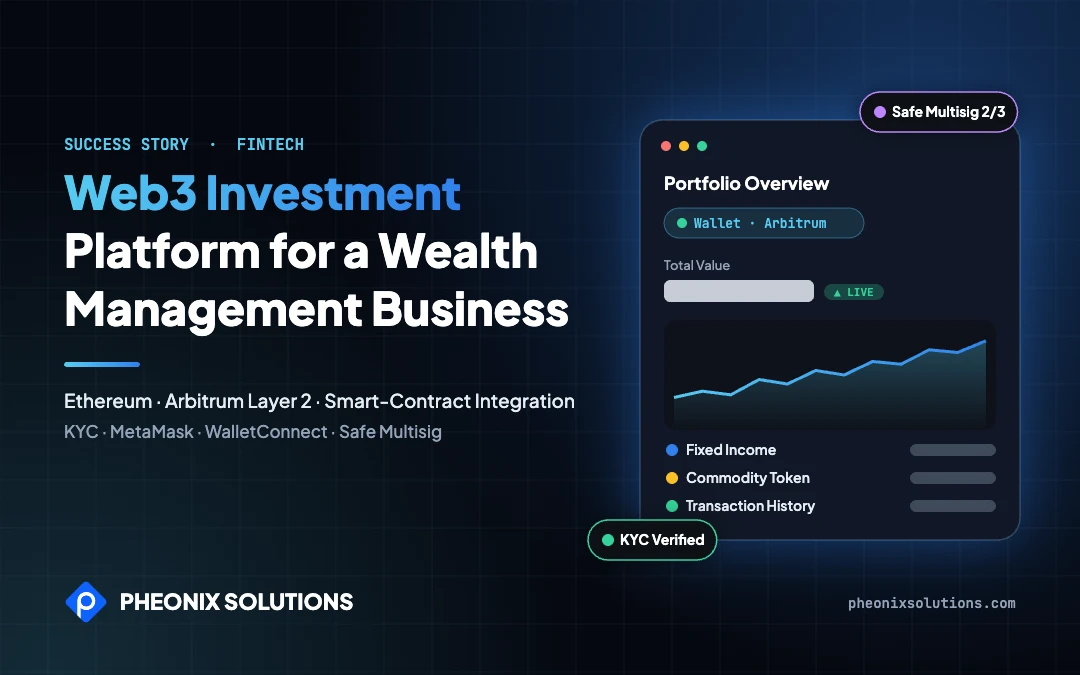
Imagine an investor who wants to put money into a bond or a gold-backed product. In most cases, that means paperwork, emails back and forth, and waiting days to see where their money stands. A growing wealth management business wanted to change that with a Web3 investment platform, where investors could sign up, get verified, connect their own crypto wallet and invest in minutes, with every transaction recorded on the blockchain.
That’s exactly where Pheonix Solutions came in. Through Web3 development, we then built that platform from the ground up and took it all the way to production.
Web3 Investment Platform Project Overview
| Industry | FinTech / Wealth Management |
| Project Type | Web3 digital investment platform |
| Blockchain | Ethereum ecosystem, running on Arbitrum (Layer 2) |
| Wallets | MetaMask, Coinbase Wallet, WalletConnect, Safe multisig |
| Services | Web3 development, smart-contract integration, web application development, DevOps |
The Challenge: Bringing Traditional Investing On-Chain
To begin with, the business already had investors and investment products. However, it lacked a digital way to run them. The team tracked products manually, approvals happened offline, and investors had no live view of their holdings.
Naturally, moving all of this onto a blockchain raised new questions. How do you make sure only verified investors can invest? How do you let people use the wallets they already trust? And how do you protect pooled funds so that no single person can move them alone?
Why Ethereum and Arbitrum?
The Ethereum ecosystem was a natural choice. After all, it’s the most widely used smart-contract platform, and almost every crypto wallet supports it. Even so, running every transaction directly on the Ethereum mainnet can be slow and expensive.
For this reason, the platform runs on Arbitrum, an Ethereum Layer 2 network. This way, investors get the same security and wallet support as Ethereum, with much faster confirmations and lower transaction fees. As a result, investing small amounts becomes practical, not painful.
Our Approach to Building the Web3 Investment Platform
In practice, we built two connected experiences on one platform:
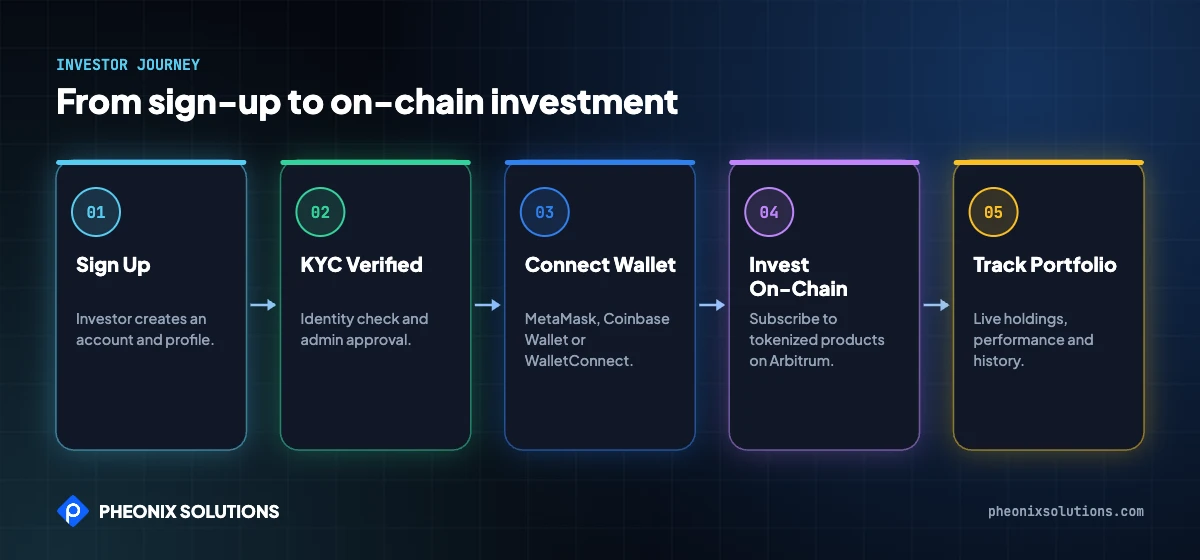
For investors, a clean portal where they sign up, complete KYC, connect a wallet and invest in tokenized fixed-income and commodity-backed products. Afterwards, their dashboard shows holdings, performance and transaction history in real time.
For administrators, a console where they review and approve KYC, manage users, and update product and fund information without touching code.
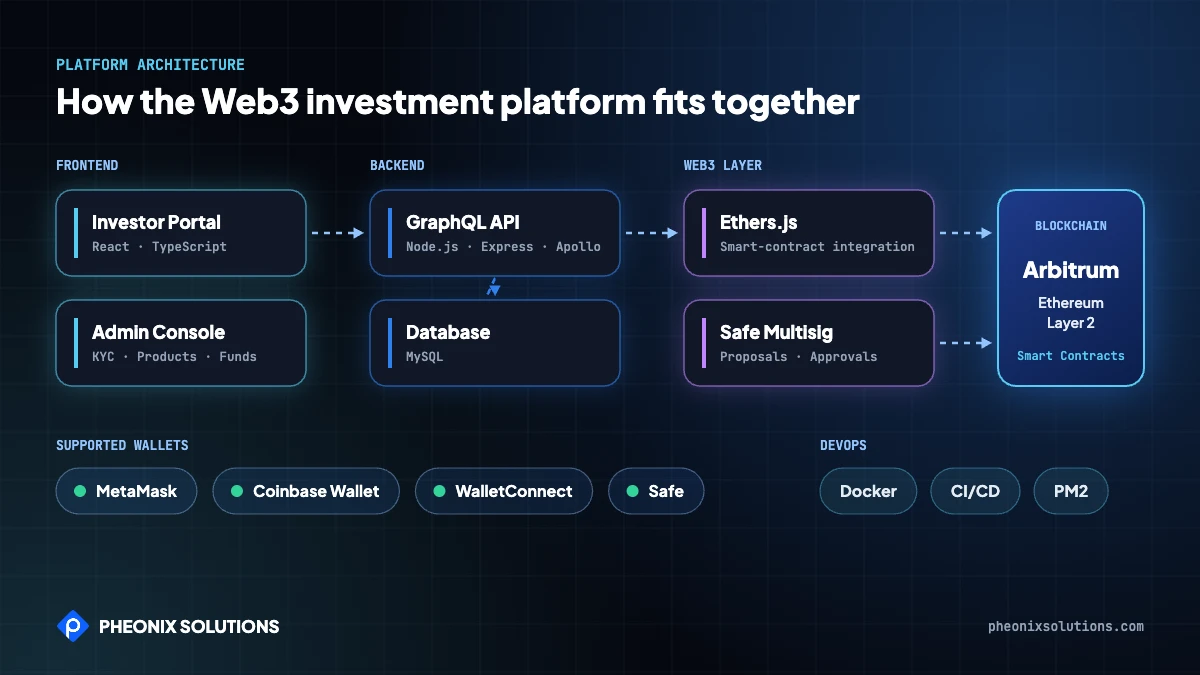
Behind the scenes, both run on a Node.js and GraphQL backend, connected to the blockchain through Ethers.js, which handles the smart-contract integrations. Like any custom software project, the platform was shaped around how the business actually works.
Key Features of the Web3 Investment Platform
Wallets Investors Already Trust
Above all, nobody wants to install a new app just to invest. The platform works with the wallets people already use:
- MetaMask and Coinbase Wallet for browser-based investors
- WalletConnect for investors on mobile wallets
- Safe multisig for fund managers, so sensitive operations need approval from several people before they go through
In short, the result is a one-click connection for investors and bank-grade approval controls for the business.
Verified Investors Only: KYC Built In
First, every investor goes through identity verification before they can invest. The KYC check is built into the sign-up flow. Then administrators approve or reject requests from their console, and investors get email updates at every step. Finally, only verified investors can access investment products.
Technology Behind the Web3 Investment Platform
- Frontend: React, TypeScript, Material UI, Chart.js
- Backend: Node.js, Express, GraphQL (Apollo), MySQL
- Web3: Ethers.js, smart-contract integration, Ethereum, Arbitrum
- Wallets: MetaMask, Coinbase Wallet, WalletConnect, Safe
- DevOps: Docker, CI/CD pipelines, PM2
The Outcome: A Secure, Scalable Web3 Investment Platform
Today, the business runs its digital investment products on one secure Web3 platform. Now investors go from sign-up to their first investment without paperwork, using a wallet they already own. At the same time, fund managers approve critical operations through multisig, and the blockchain permanently records every transaction. In addition, the platform’s modular design means new investment products can be added as the business grows.
Frequently Asked Questions
Why build on Arbitrum instead of Ethereum directly?
Arbitrum inherits Ethereum’s security. However, it processes transactions faster and at a much lower cost, which makes everyday investing practical.
Do investors need a special wallet?
No. Instead, the platform works with MetaMask, Coinbase Wallet and any WalletConnect-supported mobile wallet.
How are pooled funds protected?
Specifically, sensitive operations go through Safe multisig wallets, so several approvers must sign before any transaction goes through.
Pheonix Solutions Web3 & FinTech Expertise
In short, at Pheonix Solutions we build, deploy and run Web3 applications for FinTech businesses, from wallet and smart-contract integration to production DevOps.
Planning a Web3 or blockchain platform? Our team can help you plan, build and finally launch it.