

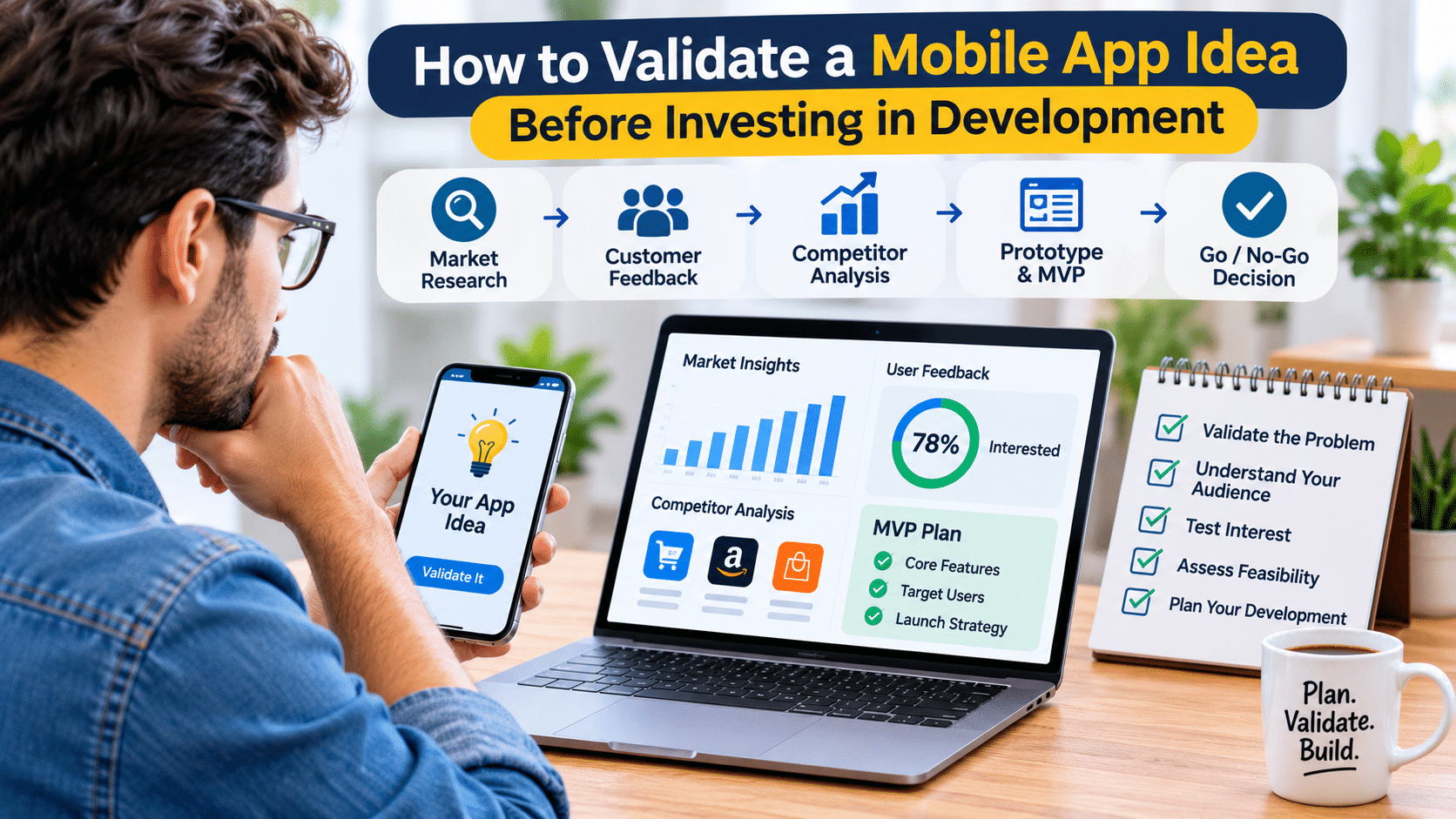
How to Validate a Mobile App Idea Before Investing in Development
Have you ever thought about building a mobile app to solve a business problem, serve customers better, or create a new revenue opportunity?
A good mobile app idea can become a valuable business product. However, having an idea does not automatically mean there is a market for it.
Many businesses invest in mobile app development based on assumptions. They spend money on design, development, integrations, and marketing before confirming whether customers actually need the application.
The result can be an app that works technically but struggles to attract users or generate revenue.
This is why validating your mobile app idea before development is important.
App idea validation helps you understand whether a real problem exists, whether people are interested in your proposed solution, how competitors address similar needs, and whether your business model is practical.
You do not need to build a complete application to answer these questions. You can start with market research, customer conversations, competitor analysis, prototypes, and a minimum viable product (MVP) plan.
In this guide, we explain how to validate a mobile app idea step by step before investing in development.
1. What Is Mobile App Idea Validation?
Mobile app idea validation is the process of evaluating whether a proposed application solves a genuine problem and has enough potential users or business value to justify development.
It involves collecting evidence before making a significant investment.
Instead of assuming customers will use your application, you investigate their needs, expectations, willingness to adopt the solution, and possible alternatives.
For example, imagine you want to develop a mobile application for local grocery stores.
Your proposed app may allow customers to:
- Browse available products.
- Check product prices.
- Place orders.
- Make online payments.
- Track deliveries.
- Receive promotional notifications.
Before developing all these features, you should investigate whether local grocery stores and their customers actually need such an application.
You may discover that customers primarily want WhatsApp ordering, while store owners need better inventory and order management.
That insight could change your original product plan and help you avoid developing unnecessary features.
The purpose of validation is simple: understand the opportunity before investing in the solution.
2. Why Should You Validate a Mobile App Idea Before Development?
Mobile app development involves more than writing code. It requires planning, design, development, testing, deployment, maintenance, and ongoing improvements.
Starting without validation can increase the risk of investing in a product that does not meet market expectations.
Here are some important reasons to validate your idea.
2.1 Understand Whether a Real Problem Exists
Successful applications usually address a specific user problem or improve an existing experience.
Before development, identify the problem your application is expected to solve.
Ask yourself:
- What problem are users currently facing?
- How frequently do they experience it?
- How are they solving it today?
- Are existing solutions inconvenient, expensive, or incomplete?
- Would an application make the process meaningfully better?
If the problem is not important to your target audience, users may have little reason to adopt another application.
2.2 Avoid Unnecessary Development Costs
Developing an application with multiple features before understanding user requirements can lead to unnecessary expenditure.
Validation helps you identify the features that matter most.
For example, instead of initially building:
- Advanced analytics
- Multiple subscription plans
- Loyalty programmes
- AI-powered recommendations
- Complex reporting dashboards
You may discover that your first version only needs user registration, product browsing, ordering, payment, and order tracking.
This allows you to focus your initial investment on essential functionality.
2.3 Identify Your Target Audience
An application designed for everyone may struggle to address anyone’s specific requirements.
Validation helps you identify the people most likely to use your application.
Your target audience could include:
- Individual consumers
- Small businesses
- Retail shop owners
- Educational institutions
- Healthcare providers
- Service professionals
- Enterprise customers
Understanding your audience influences the application design, features, pricing, marketing, and development priorities.
2.4 Understand Your Competition
Your application may not be the first solution addressing a particular problem.
Competitor research helps you understand existing products, their strengths, limitations, pricing, and customer feedback.
This can help you identify opportunities to offer a better or more specialised solution.
2.5 Improve Your Business Model
An application may attract users but still fail to generate enough revenue to support its development and operation.
Validation helps you evaluate how the product could generate income.
Possible revenue models include:
- One-time purchases
- Monthly or annual subscriptions
- Transaction fees
- Commission-based revenue
- In-app purchases
- Premium features
- Business licensing
You should evaluate whether your target customers are willing to pay and whether the expected revenue can support the product’s costs.
3. Step-by-Step Process to Validate Your Mobile App Idea
You can validate your mobile app idea through a structured process without immediately starting full-scale development.
Step 1: Clearly Define the Problem Your App Will Solve
Start by writing down the problem your application intends to address.
Avoid beginning with a long list of features. Focus first on the user problem.
For example:
App idea: A mobile application for appointment booking.
Problem: Customers find it difficult to contact service providers, check availability, and confirm appointments.
Proposed solution: An application that allows customers to discover service providers, view available time slots, book appointments, and receive reminders.
This simple description creates a clear foundation for your validation activities.
Try completing the following statement:
“Our application helps [target audience] solve [specific problem] by providing [proposed solution].”
If you cannot explain the problem and solution clearly, you may need to refine the idea before moving forward.
Step 2: Identify Your Target Customers
Determine who will benefit most from your application.
Do not assume that every smartphone user is a potential customer.
Create a simple customer profile based on:
- Age group, where relevant
- Location
- Occupation or business type
- Existing behaviour
- Technology usage
- Spending habits
- Specific problems
- Expectations from the proposed application
For example, if you are developing an inventory management app, your primary audience may be small retailers, wholesalers, and distributors rather than general consumers.
You should also identify who makes the purchasing decision. In a business application, the person using the app may not be the person paying for it.
Step 3: Conduct Market Research
Market research helps you understand whether there is a potential market for your application.
You can begin with publicly available information and direct customer research.
Explore:
- Industry trends
- Existing applications
- Customer discussions
- Search engine results
- Industry reports
- Social media conversations
- Relevant online communities
- Customer reviews of competing products
Look for repeated problems and unmet needs.
For example, if several small business owners complain about managing orders from multiple sales channels, this could indicate an opportunity for a centralised order management solution.
However, market size alone does not prove demand for your specific application. You should combine market research with direct feedback from potential customers.
Step 4: Analyse Existing Competitors
Search for applications that offer similar features or solve the same problem.
You can explore competitors through:
- Google Play Store
- Apple App Store
- Competitor websites
- Product demonstrations
- Customer reviews
- Social media pages
Prepare a comparison of their features, pricing, target customers, and user feedback.
| Evaluation Area | What to Investigate |
|---|---|
| Target audience | Who uses the application? |
| Core features | What problems does it solve? |
| Pricing | Is it free, subscription-based, or paid? |
| User experience | Is the application easy to use? |
| Reviews | What do customers appreciate or complain about? |
| Limitations | Which important requirements are missing? |
| Market positioning | How does it differentiate itself? |
Pay particular attention to negative reviews.
For example, customers may complain about complicated registration, poor customer support, missing features, or unreliable performance.
These observations can help you identify opportunities to improve your proposed application.
Remember that having competitors does not automatically make your idea unsuitable. Competition can also indicate that customers already recognise the problem and are willing to use solutions.
Your objective should be to identify a meaningful difference rather than simply creating another similar application.
Step 5: Talk to Potential Customers
Customer interviews are among the most useful ways to validate an app idea.
Speak directly with people who may use or purchase your application.
Avoid asking only whether they like your idea. People may express interest in a concept without actually intending to use or pay for it.
Instead, ask about their existing experiences and behaviour.
Useful questions include:
- How do you currently solve this problem?
- What is the most difficult part of the process?
- How frequently do you face this problem?
- Have you tried any existing applications or services?
- What do you dislike about the current solutions?
- What would make you consider switching to another solution?
- Would you pay for a solution that addresses this problem?
- Which features would be most important to you?
For business applications, ask business owners about their current processes, operating costs, and the time spent handling the problem.
Try to speak with a representative range of potential users rather than relying only on friends, colleagues, or people who already support your idea.
Step 6: Create a Basic Feature List
Once you understand the problem and customer expectations, prepare a list of possible application features.
Divide them into three categories.
Essential Features
These are necessary for the application to deliver its primary value.
For an appointment booking application:
- User registration
- Service provider listing
- Availability display
- Appointment booking
- Booking confirmation
Important Future Features
These improve the application but may not be essential for the first release.
Examples:
- Customer reviews
- Loyalty rewards
- Advanced notifications
- Appointment history
- Promotional offers
Advanced Features
These can be considered after the product demonstrates demand.
Examples:
- AI-powered recommendations
- Advanced analytics
- Automated customer segmentation
- Complex third-party integrations
- Predictive reporting
This classification helps prevent unnecessary feature expansion during the initial development stage.
Step 7: Build a Prototype or Wireframe
A prototype allows potential users to understand how your application may work without developing the complete product.
A wireframe is a basic visual representation of the application screens and navigation.
For example, a shopping application prototype may include:
- Login screen
- Home screen
- Product listing
- Product details
- Shopping cart
- Checkout
- Order confirmation
You can create simple screen designs using prototyping tools or work with a UI/UX designer.
Show the prototype to potential users and observe how they interact with it.
Ask:
- Can they understand the navigation?
- Can they find the main feature?
- Is the ordering or booking process clear?
- Are any important steps missing?
- Would they use this solution instead of their current process?
A prototype helps identify usability problems before development begins.
Step 8: Test Interest Through a Landing Page
Another way to evaluate demand is to create a simple landing page describing your proposed application.
The page can explain:
- The problem being addressed
- The intended audience
- The main benefits
- A few proposed features
- Expected availability
- A way to register interest
You can include a call to action such as:
- Join the Early Access List
- Request a Product Demo
- Register Your Interest
- Get Launch Updates
You can share the landing page through relevant communities, existing business contacts, social media, or targeted advertising.
Measure meaningful actions such as registrations, demo requests, and qualified enquiries.
A visitor who submits a detailed enquiry may provide stronger evidence of interest than someone who simply views the page.
However, landing-page registrations are only an early demand signal. They do not guarantee that people will install, regularly use, or pay for the finished application.
Step 9: Evaluate Your Revenue Model
If your application is intended to become a business, identify how it will generate revenue.
Consider the following models.
| Revenue Model | How It Works | Example |
|---|---|---|
| Subscription | Users pay periodically | Monthly business management app |
| One-time purchase | Users pay once | Paid utility application |
| Commission | You earn from transactions | Booking or service marketplace |
| Freemium | Basic features are free, premium features are paid | Productivity application |
| In-app purchases | Users pay for additional features or content | Learning application |
| Business licensing | Businesses pay to use the solution | Enterprise management app |
Consider your target customers’ willingness to pay, competing products, payment costs, and the ongoing expenses of operating the application.
For example, a business app charging ₹499 per month must attract enough paying customers to cover hosting, support, maintenance, marketing, and development costs.
Do not base your financial projections only on the total number of potential users. Estimate how many users you can realistically acquire and convert into paying customers.
Step 10: Assess Technical and Operational Feasibility
Before starting development, evaluate whether the proposed application can be built and maintained within your budget and expected timeline.
Consider:
- Android and iOS requirements
- Web-based administration requirements
- Backend and database needs
- Third-party API integrations
- Payment gateway requirements
- Security and privacy considerations
- Expected user volume
- Hosting infrastructure
- Maintenance and support
Some applications are relatively straightforward, while others require complex integrations, real-time communication, location services, or large-scale infrastructure.
You should also identify external dependencies, such as payment providers, mapping services, messaging platforms, and app store approval requirements.
Discuss the technical scope with an experienced mobile app development team before finalising your investment decision.
4. What Is an MVP, and Why Is It Important for App Validation?
An MVP, or Minimum Viable Product, is an initial version of an application that includes only the essential functionality needed to deliver its core value and learn from actual users.
Instead of developing every planned feature, you launch a smaller, usable product and collect feedback.
For example, consider an app idea for connecting customers with local service providers.
Your complete application may eventually include:
- Customer registration
- Service provider registration
- Search and filtering
- Location-based discovery
- Appointment booking
- Online payments
- Reviews and ratings
- Notifications
- Provider dashboards
- Reports and analytics
However, the first MVP may only need:
- Customer registration
- Service provider listings
- Basic search
- Appointment requests
- Booking confirmation
Once users begin interacting with the application, you can understand which additional features are necessary.
Benefits of an MVP include:
- Lower initial development scope
- Faster access to real user feedback
- Early identification of usability problems
- Better understanding of feature priorities
- Reduced risk of building unnecessary functionality
- More informed decisions about future investment
An MVP should still be reliable, secure, and usable. It should not be treated as an unfinished product that is released without adequate testing.
5. How Much Does It Cost to Validate a Mobile App Idea?
The cost of validation depends on how much research and testing your idea requires.
You do not necessarily need to invest in full mobile app development during the validation stage.
| Validation Activity | Possible Approach | Cost Consideration |
|---|---|---|
| Problem research | Online research and customer interviews | Can often start with minimal spending |
| Competitor analysis | Review existing applications and websites | May be completed internally |
| Customer surveys | Online survey tools | Depends on the tool and audience |
| Wireframes | Basic screen layouts | Depends on design requirements |
| Interactive prototype | Clickable application demonstration | Depends on design complexity |
| Landing page | Simple website explaining the idea | Depends on development and hosting |
| Market testing | Targeted campaigns and promotions | Depends on advertising budget |
| MVP development | Build essential working features | Depends on scope and integrations |
The goal is to spend enough to gather useful evidence without committing prematurely to the full product.
A sensible approach is to move from low-cost research to more detailed testing only when the previous stage provides encouraging evidence.
6. Common Mistakes to Avoid When Validating an App Idea
Even with a structured process, businesses can make mistakes that lead to incorrect conclusions.
Mistake 1: Building Based Only on Personal Assumptions
An idea may seem useful to you, but your target customers may not experience the same problem.
Better approach: Speak with potential users and investigate how they currently solve the problem.
Mistake 2: Asking Only Whether People Like the Idea
Positive feedback does not necessarily indicate real demand.
Better approach: Ask about actual behaviour, existing spending, current challenges, and willingness to try or pay for a solution.
Mistake 3: Ignoring Competitors
Assuming that no one has developed a similar application can lead to missed market information.
Better approach: Research direct competitors and alternative solutions, including manual processes.
Mistake 4: Planning Too Many Features
Adding every suggested feature can increase development costs and delay launch.
Better approach: Prioritise the essential features that solve the main problem.
Mistake 5: Ignoring Marketing and Customer Acquisition
Developing an application does not automatically bring users.
Better approach: Plan how you will reach potential customers before development begins.
Mistake 6: Underestimating Ongoing Costs
Development is only one part of the investment.
Applications also require hosting, maintenance, security updates, support, and improvements.
Better approach: Estimate both initial development costs and ongoing operating expenses.
Mistake 7: Treating Downloads as Business Success
A high number of downloads does not necessarily mean that users find the application valuable.
Better approach: Track meaningful indicators such as active users, repeat usage, completed transactions, retention, and paid conversions.
7. How Do You Know Whether Your App Idea Is Ready for Development?
After completing the validation activities, review the evidence you have collected.
Your idea may be ready for the next stage when you can answer these questions confidently:
| Validation Question | What You Should Know |
|---|---|
| Is there a real problem? | The target audience experiences a clearly identified problem. |
| Who are the users? | You have defined a specific target audience. |
| Is there market interest? | Research and customer feedback indicate genuine interest. |
| What alternatives exist? | You understand competitors and existing solutions. |
| What makes your app different? | You can explain its value clearly. |
| What are the essential features? | You have prioritised the first release. |
| Is the business model practical? | You have a realistic revenue approach. |
| Is development feasible? | You understand the technical requirements and dependencies. |
| How will you acquire users? | You have an initial marketing and distribution plan. |
| Can you support the product? | You have considered maintenance, hosting, security, and support. |
You can also use the following simple readiness checklist:
- The problem is clearly defined.
- The target audience is identified.
- Market research has been completed.
- Competitors have been evaluated.
- Potential customers have been interviewed.
- Essential features have been prioritised.
- A prototype or wireframe has been reviewed.
- Early customer interest has been measured.
- The revenue model has been evaluated.
- Technical feasibility has been discussed.
- Initial and ongoing budgets have been considered.
You do not need perfect answers to every question. However, significant unanswered questions should be addressed before committing to a large development investment.
8. What Happens After Validating Your Mobile App Idea?
Once your idea has passed the initial validation stage, you can move towards structured product development.
A typical process includes the following stages.
1. Finalise Product Requirements
Document the application purpose, target users, core features, user journeys, integrations, and expected outcomes.
2. Prepare the UI/UX Design
Create application screens and navigation flows based on the validated requirements.
3. Select the Technology Approach
Decide whether you need native Android and iOS applications, cross-platform development, a backend system, or an administrative web portal.
The choice should depend on functionality, performance, budget, and future requirements.
4. Plan MVP Development
Prepare a development scope that includes only the features necessary for the first release.
Define milestones, testing requirements, responsibilities, and acceptance criteria.
5. Develop and Test the Application
Build the application and conduct functional, usability, compatibility, security, and performance testing appropriate to the product.
6. Launch and Collect Feedback
Release the application to the intended audience through an appropriate distribution method.
Monitor usage, feedback, technical issues, and business performance.
7. Improve Based on Actual Usage
Use real user behaviour and feedback to decide which features to improve, add, or remove.
This approach helps your product evolve based on evidence rather than assumptions.
9. Frequently Asked Questions
How do I know if my mobile app idea is worth developing?
Start by identifying the problem your application solves and researching whether your target audience experiences it. Conduct customer interviews, analyse competitors, test a prototype, and measure genuine interest. If the evidence supports the opportunity and the business model is practical, you can proceed towards development.
Can I validate an app idea without developing an application?
Yes. You can begin with market research, surveys, customer interviews, wireframes, clickable prototypes, and landing pages. These methods help you understand customer needs and evaluate interest before investing in a working application.
How many people should I interview to validate an app idea?
There is no universal number that guarantees validation. Start with a representative group of people from your intended target audience. The quality of the conversations and the consistency of the problems identified are more important than collecting a large number of superficial responses.
For specialised or business-to-business applications, you may need to speak with different customer roles and decision-makers.
What is the difference between an MVP and a prototype?
A prototype demonstrates how an application may look and work. It is generally used to test design, navigation, and user experience.
An MVP is a working product with essential functionality that allows actual users to experience the core solution.
Should I build an Android app or an iOS app first?
The decision depends on your target audience, customer preferences, market, budget, and business requirements. Research which devices your intended users prefer before selecting the development approach.
In some cases, cross-platform development may be worth considering.
How much does mobile app development cost?
Mobile app development costs depend on the features, design, platforms, backend requirements, third-party integrations, security needs, and development complexity.
A basic application and a complex business platform can have very different budgets. Prepare a detailed requirement document and obtain a scope-based estimate before starting development.
What if customers do not show enough interest in my app idea?
Low interest is useful feedback. It may indicate that the problem is not important enough, the target audience is incorrect, or the proposed solution needs improvement.
You can refine the idea, change the target segment, simplify the features, or explore a different problem before investing further.
Should I hire a mobile app development company before validating my idea?
You can conduct initial research independently. However, involving an experienced development team during the planning stage can help you assess technical feasibility, identify hidden dependencies, estimate the development scope, and plan an appropriate MVP.
You do not need to begin full development simply because you consult a development company.
Conclusion: Validate First, Develop with Confidence
A promising mobile app idea deserves proper research before it becomes a development project.
By identifying a real problem, understanding your target customers, researching competitors, collecting feedback, testing prototypes, and evaluating the business model, you can make a more informed investment decision.
You do not need to build a complete application to discover whether an opportunity exists.
Start small, gather evidence, prioritise essential features, and develop an MVP when the idea is sufficiently validated.
Most importantly, remember that successful app development is not only about building features. It is about creating a solution that people need, understand, and are willing to use.
Plan Your Mobile App Project with PheonixSolutions
Have a mobile app idea but need help turning it into a practical development plan?
PheonixSolutions helps businesses plan and develop mobile applications based on their goals, customer requirements, and operational needs.
Our mobile app development services can support you with:
- Mobile app requirement analysis
- UI/UX design and prototyping
- Android and iOS application development
- Cross-platform application development
- Backend and API integration
- Payment gateway integration
- Application testing and deployment
- Ongoing maintenance and support
Whether you are planning a new startup application, a customer-facing mobile app, or an internal business application, the right planning and development approach can help you move forward with clarity.
Plan Your App Project
Explore our Mobile App Development Services and discuss your application requirements with PheonixSolutions.