

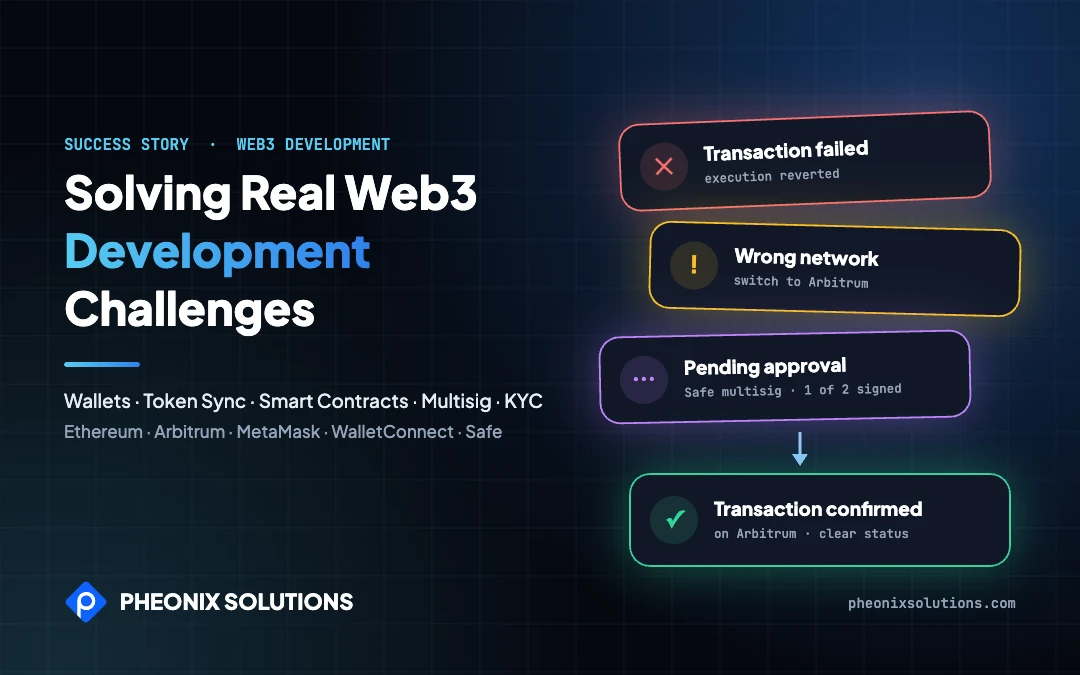
Every Web3 development project starts with the same easy plan: connect a wallet, call a smart contract, show the balance. Then real users arrive. One investor’s wallet won’t connect. Another sees an empty portfolio even though the tokens are clearly in their wallet. A trade fails with nothing but “execution reverted”. Meanwhile, the fund manager’s multisig wallet won’t send anything at all.
That’s exactly what our team faced while building a Web3 investment platform for a wealth management business. The platform runs on Arbitrum, an Ethereum Layer 2 network, and connects to MetaMask, Coinbase Wallet, WalletConnect and Safe multisig wallets. This is the story of the problems we hit, and how we fixed each one.
Web3 Development Project Overview
| Industry | FinTech / Wealth Management |
| Project Type | Web3 digital investment platform |
| Blockchain | Ethereum ecosystem, running on Arbitrum (Layer 2) |
| Wallets | MetaMask, Coinbase Wallet, WalletConnect, Safe multisig |
| Technology | React, TypeScript, Node.js, GraphQL, Ethers.js |
| Services | Web3 development, smart-contract integration, KYC onboarding, DevOps |
Challenge 1: “Why Won’t My Wallet Connect?”
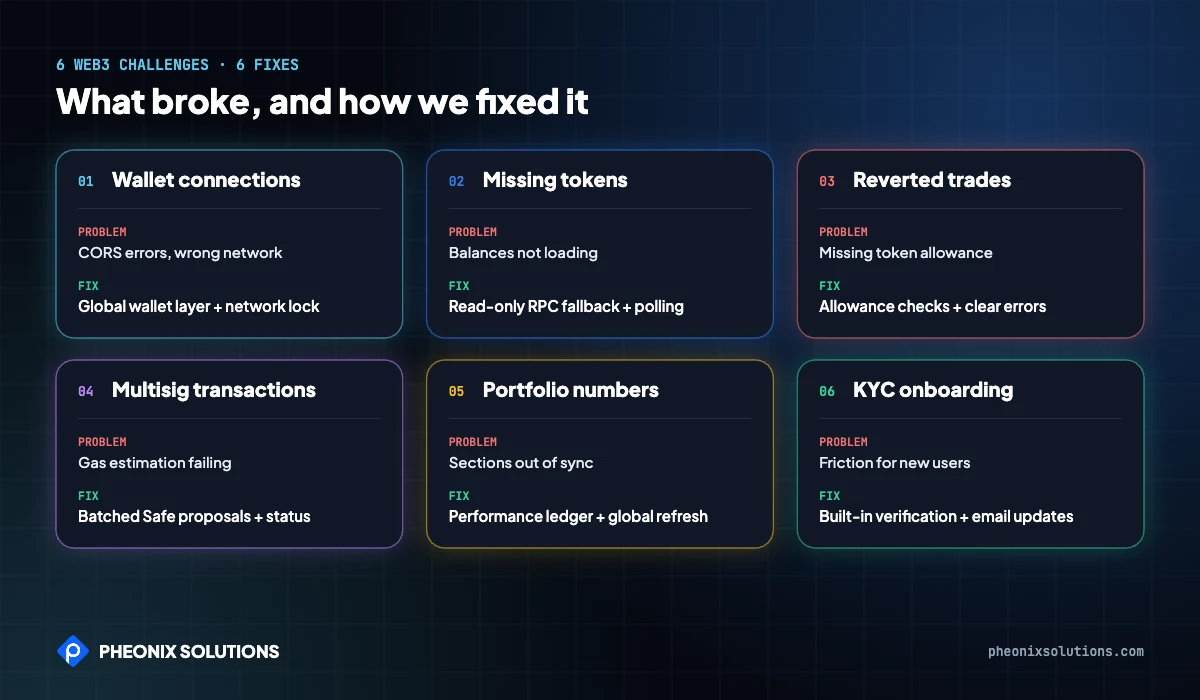
What went wrong: Wallet connections were the first headache. Public RPC endpoints blocked requests with CORS errors. In addition, some investors were on the wrong network without knowing it. WalletConnect also produced harmless background relay messages that showed up as alarming error pop-ups, so users thought something was broken when it wasn’t.
How we fixed it: First, we rebuilt the wallet layer as one global connection that every page shares, so a wallet connected once stays connected everywhere. Next, custom RPC mapping removed the CORS failures. The app now locks itself to Arbitrum, so a transaction can never go to the wrong chain. Finally, we silenced the harmless relay noise and added a connection diagnostic screen for the errors that really matter.
Challenge 2: The Case of the Missing Tokens
What went wrong: Some investors opened their dashboard and saw nothing. Their tokens were safely on-chain. However, certain wallet environments restricted how the app could read data, so balances and token lists never loaded. Imagine checking your investment and seeing zero.
How we fixed it: We added a read-only fallback connection to the blockchain with automatic polling. If the wallet’s own connection is restricted, the platform reads balances directly from Arbitrum and keeps refreshing them. As a result, investors now always see what they actually own.
Challenge 3: “Execution Reverted” and Other Mysteries
What went wrong: Some trades failed inside the smart contract with cryptic revert errors. The most common cause was simple: the investor hadn’t approved the token allowance before opening a position. Yet all they saw was a technical error with no clue what to do next.
How we fixed it: The platform now checks token allowances before every trade, so the approval step always comes first. We also built a central error translator that turns raw blockchain errors into plain-English messages, for example “Please approve the token first”. On top of that, one consistent notification style now runs across the whole app.
Challenge 4: The Multisig Wallet That Couldn’t Send
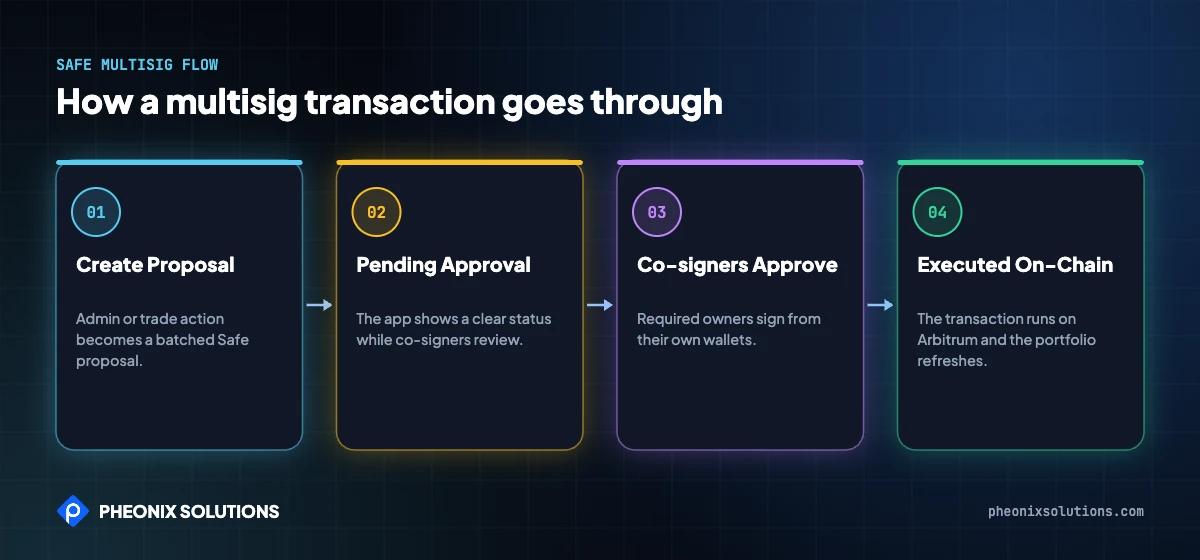
What went wrong: The business protects its pooled funds with Safe multisig wallets, where several people must sign before any transaction goes through. Normal smart-contract calls kept failing here, because gas estimation works differently when a transaction is a proposal waiting for signatures. To make it worse, users couldn’t tell whether a transaction had failed or was just waiting for approval.
How we fixed it: We routed admin and trade operations through batched transactions that create proper Safe proposals. We also added a clear “Pending approval” status, so users know the transaction is waiting for co-signers. In addition, fund managers can now connect their Safe in one click through deep linking.
Challenge 5: Portfolio Numbers That Didn’t Agree
What went wrong: After a trade, different parts of the portfolio dashboard sometimes showed different numbers. One section updated, another didn’t, and performance metrics jumped around. In finance, numbers that don’t match destroy trust fast.
How we fixed it: We built a wallet-based performance ledger with automatic baselines, so the platform measures returns consistently from day one. A global refresh now updates every portfolio section together after each transaction. Besides that, simple in-app explanations help investors understand what each metric means.
Challenge 6: KYC Without the Friction
What went wrong: A FinTech platform must verify every investor. Still, a clunky KYC process scares new users away before they invest a single dollar.
How we fixed it: We integrated a trusted third-party identity verification service directly into the sign-up flow. Administrators approve or reject requests from their own console, and investors get email updates at every stage, from registration to KYC status to account approval. Investment products unlock only after verification, which keeps the platform compliant without slowing investors down.
The Outcome: Web3 Development That Holds Up in Production
What began as a list of blockchain headaches became a stable, production-ready Web3 platform. Investors now connect with MetaMask, Coinbase Wallet or WalletConnect, see accurate balances, trade with clear feedback and track a portfolio they can trust. Meanwhile, fund managers approve critical operations securely through Safe multisig, all on fast, low-cost Arbitrum.
Most importantly, “Transaction failed” is no longer a mystery. When something needs attention, the platform tells users exactly what and why. You can read more about the platform itself in our Web3 investment platform success story.
Frequently Asked Questions
Why do transactions fail so often in Web3 development?
The usual causes are a wrong network, a missing token approval or an RPC limit. Checking these before each transaction and showing clear error messages prevents most failures.
Can Web3 development include Safe multisig wallets?
Yes, but it needs a proposal-and-approval flow rather than direct contract calls, plus clear status updates while signatures are pending.
Is KYC possible in Web3 development?
Yes. Identity checks happen off-chain, and access to on-chain products opens only after verification.
Pheonix Solutions Web3 Development Expertise
At Pheonix Solutions, we build, deploy and run Web3 applications, from wallet and smart-contract integration to production DevOps. When a blockchain project gets stuck, we find out why and fix it.
Stuck with wallet, transaction or smart-contract issues? Our team can help you get your Web3 project back on track.