
Post Date: January 24, 2019
Last Updated: October 06, 2026
Introduction
This guide explains how to install Control Web Panel — a free server administration tool for managing dedicated and VPS servers without needing SSH for every small task.
One important update since the original version of this guide: the product has rebranded from “CentOS Web Panel” to “Control Web Panel” (CWP), now hosted at control-webpanel.com rather than the old centos-webpanel.com domain. It’s also worth knowing that CentOS 6 is no longer supported at all (EOL since 2020) and CentOS 7 reached end-of-life in June 2024 — CWP now also supports Rocky Linux, AlmaLinux, and Oracle Linux, which are better choices for a new installation today.
Prerequisites
- A freshly installed, unconfigured server (CWP’s installer expects a clean environment)
- Root/SSH access
- A static IP address (dynamic or internal-only IPs aren’t supported by the installer)
- Minimum 1GB RAM (64-bit), 10GB free disk space
Architecture
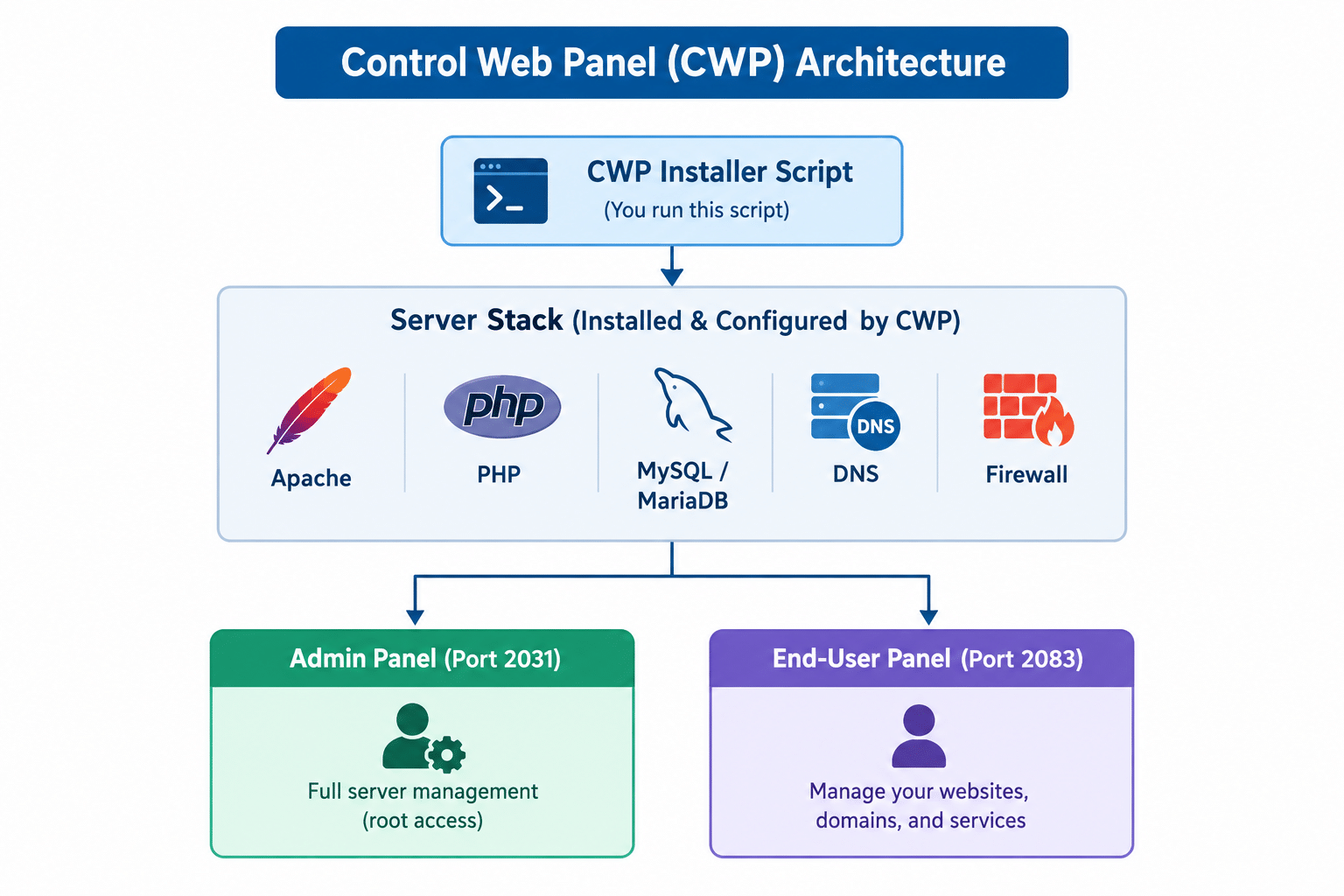
- CWP installs and configures a full server stack for you — Apache, PHP, MySQL/MariaDB, DNS, and a firewall — compiled and set up by its installer script
- It then runs its own admin panel (port 2031 by default) and a separate end-user panel (port 2083) on top of that stack
- Both panels manage the real underlying server configuration directly — there’s no separate “CWP database” abstracted away from the actual system
Steps
1. Set the Hostname (Recommended First Step)
hostnamectl set-hostname cwp.yourdomain.com
2. Update the System and Install wget
yum -y update
yum -y install wget
3. Download and Run the CWP Installer
For CentOS/RHEL 7-compatible systems:
cd /usr/local/src
wget https://control-webpanel.com/cwp-el7-latest
sh cwp-el7-latest
For CentOS/RHEL 8-compatible systems (Rocky, AlmaLinux, Oracle Linux):
cd /usr/local/src
wget https://control-webpanel.com/cwp-el8-latest
sh cwp-el8-latest
Note: The original guide included CentOS 6 instructions — CentOS 6 is no longer supported by CWP at all, so that path has been dropped here. It also used the old
centos-webpanel.comdomain and plainhttp://links; the URLs above reflect the product’s current name and use HTTPS.
The installation compiles Apache and PHP from source, so this step can take a while — let it run to completion.
4. Reboot the Server
reboot
This applies all changes and starts CWP’s services.
5. Log In
Admin panel (root access):
https://your-server-ip:2031
End-user panel:
https://your-server-ip:2083
Security note: Demo credentials like
root/admin123(as shown in some older guides and CWP’s own public demo site) are for trying out the interface only — never use a default or simple password like this on a real server. Set a strong, unique password during setup, and change it immediately if the installer assigned a default one.
Conclusion
Installing Control Web Panel comes down to running its installer script on a clean, currently supported server, then logging in through the admin or user panel once it finishes. The main things that changed since the original guide: the product’s rebrand from CentOS Web Panel, dropped support for CentOS 6, and CentOS 7 itself now being past end-of-life — Rocky Linux or AlmaLinux are the better target for a fresh install today.
Frequently Asked Questions
Why is it called Control Web Panel now instead of CentOS Web Panel? The project rebranded, moving to control-webpanel.com as its official domain. The functionality and installation approach remain conceptually the same.
Can I uninstall CWP if I change my mind? No — CWP doesn’t provide an uninstaller. Removing it requires reinstalling the OS from scratch, so only install it on a server you’re comfortable dedicating entirely to it.
Does CWP still work on CentOS 7? Technically yes, but CentOS 7 is past end-of-life and no longer receives security patches. Rocky Linux or AlmaLinux are the recommended targets for new installations.
Related Articles
How to install MySQL 8.0 on CentOS 7
How to Install Kubernetes Cluster Using K3s on Centos 7
Talk to Our Technology Experts
Setting up a new control panel or migrating your server management tools? Our team can help with server provisioning, control panel setup, and ongoing support.