
Introduction
Managing files on remote servers is a common task for system administrators, developers, and website owners. While traditional FTP clients provide basic file transfer capabilities, LFTP offers a powerful command-line alternative with advanced features such as parallel downloads, directory mirroring, scripting support, and secure file transfers.
In this guide, you’ll learn how to install LFTP, connect to FTP/SFTP servers, upload and download files, synchronize directories, and automate transfers through scripts.
What is LFTP?
LFTP is a sophisticated command-line file transfer program that supports multiple protocols, including:
- FTP
- FTPS
- SFTP
- HTTP
- HTTPS
- FISH
Unlike standard FTP clients, LFTP provides features such as resumable transfers, segmented downloads, automated synchronization, and scripting capabilities, making it ideal for both interactive use and automation.
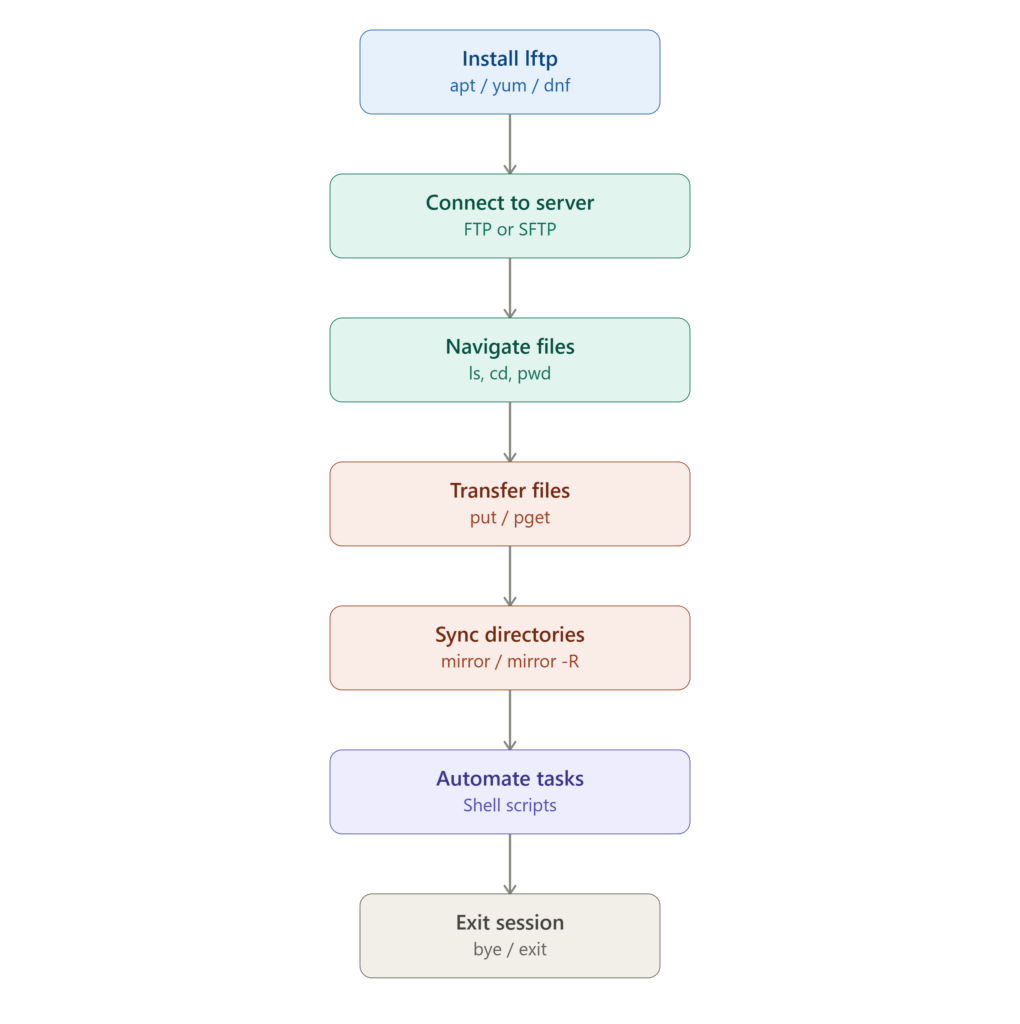
LFTP Workflow Chart
Installing LFTP
Install LFTP on Ubuntu
On Ubuntu and Debian-based distributions, install LFTP using the APT package manager:
sudo apt-get update
sudo apt-get install lftp
Install LFTP on CentOS, Fedora, and RHEL
For CentOS, Fedora, and RHEL systems, use YUM or DNF:
sudo yum install lftp
For newer Fedora and RHEL versions:
sudo dnf install lftp
Connecting to an FTP or SFTP Server
Before connecting, ensure you have:
- FTP/SFTP username
- Server hostname or IP address
- Password (if required)
Connect to your server using:
lftp ftp://username@hostname
For SFTP connections:
lftp sftp://username@hostname
You will be prompted for the password if it is not provided in the command.
Basic Navigation Commands
Once connected, you can navigate the remote server similarly to a Linux shell.
List Files and Directories
ls
Change Directory
cd directory_name
Display Current Directory
pwd
Downloading Files with PGET
LFTP’s pget command downloads files using multiple connections, which can significantly improve download speeds.
pget file_from_server.txt
This command retrieves the specified file from the remote server to your local machine.
Uploading Files with PUT
To upload a local file to the remote server:
put file_from_workspace_file.txt
The file will be transferred from your current local directory to the current remote directory.
Mirroring Directories to the Server
One of LFTP’s most powerful features is directory synchronization.
Reverse Mirror (Upload Local Directory to Server)
mirror -R
Example:
mirror -R /home/user/project /public_html/project
The -R option performs a reverse mirror, copying local files and directories to the remote server.
Download a Remote Directory
mirror /remote/directory /local/directory
This synchronizes files from the server to your local machine.
Exiting the LFTP Session
To leave the LFTP shell, run:
bye
or
exit
Automating File Transfers with Scripts
LFTP commands can be executed directly from shell scripts without entering an interactive session.
Example:
lftp -e 'mirror /home/user/ /home/user/Videos/; quit' \
-u user,password ftp://ip
This command:
- Connects to the FTP server.
- Mirrors the specified directory.
- Exits automatically after completion.
This approach is particularly useful for scheduled backups, deployments, and synchronization tasks.
Best Practices for Using LFTP
- Use SFTP whenever possible for secure file transfers.
- Automate routine uploads and backups using shell scripts.
- Verify synchronization paths before running mirror operations.
- Use segmented downloads with
pgetfor large files. - Store credentials securely and avoid hardcoding passwords in scripts.
Conclusion
LFTP is a versatile and powerful file transfer tool that goes far beyond the capabilities of traditional FTP clients. With support for FTP, SFTP, automated mirroring, parallel downloads, and scripting, it is an excellent choice for administrators and developers who need reliable file management on remote servers.
Whether you’re transferring a single file, synchronizing an entire website, or automating server backups, LFTP provides a fast and efficient solution that can significantly streamline your workflow.
Frequently Asked Questions (FAQ)
1. What is the difference between FTP and LFTP?
FTP is a file transfer protocol, while LFTP is a command-line client that uses FTP, SFTP, FTPS, and other protocols to transfer files. LFTP includes advanced features such as mirroring, scripting, and segmented downloads.
2. Is LFTP secure?
LFTP itself supports secure protocols such as SFTP and FTPS. For encrypted file transfers, it is recommended to use SFTP instead of standard FTP.
3. Can I automate file uploads and backups with LFTP?
Yes. LFTP can be integrated into shell scripts and cron jobs, making it ideal for automating backups, deployments, and directory synchronization.
Related Articles
1.How to Fix the OpenSSH SFTP Server “Subsystem Not Found” Error
2.Why WordPress Requests FTP Credentials During Plugin Installation
3.Resolving WordPress FTP Credential Prompts When Installing Plugins
Talk to our experts
Looking for the right technology solution for your business? Our team of experts can help you with development, cloud, DevOps, design, and a wide range of other technology needs. Get in touch with our team here.