
Understanding On-Chain and Off-Chain in Blockchain
Blockchain technology is often described as decentralized and trustless, but in practice, most real-world blockchain applications are built using a combination of on-chain and off-chain systems. Understanding how these two layers work together is essential for building scalable, secure, and user-friendly blockchain platforms.
What is On-Chain?
On-chain refers to all operations that take place directly on the blockchain. These operations are executed through smart contracts and validated by the blockchain network. Once confirmed, on-chain data becomes permanent and cannot be altered.
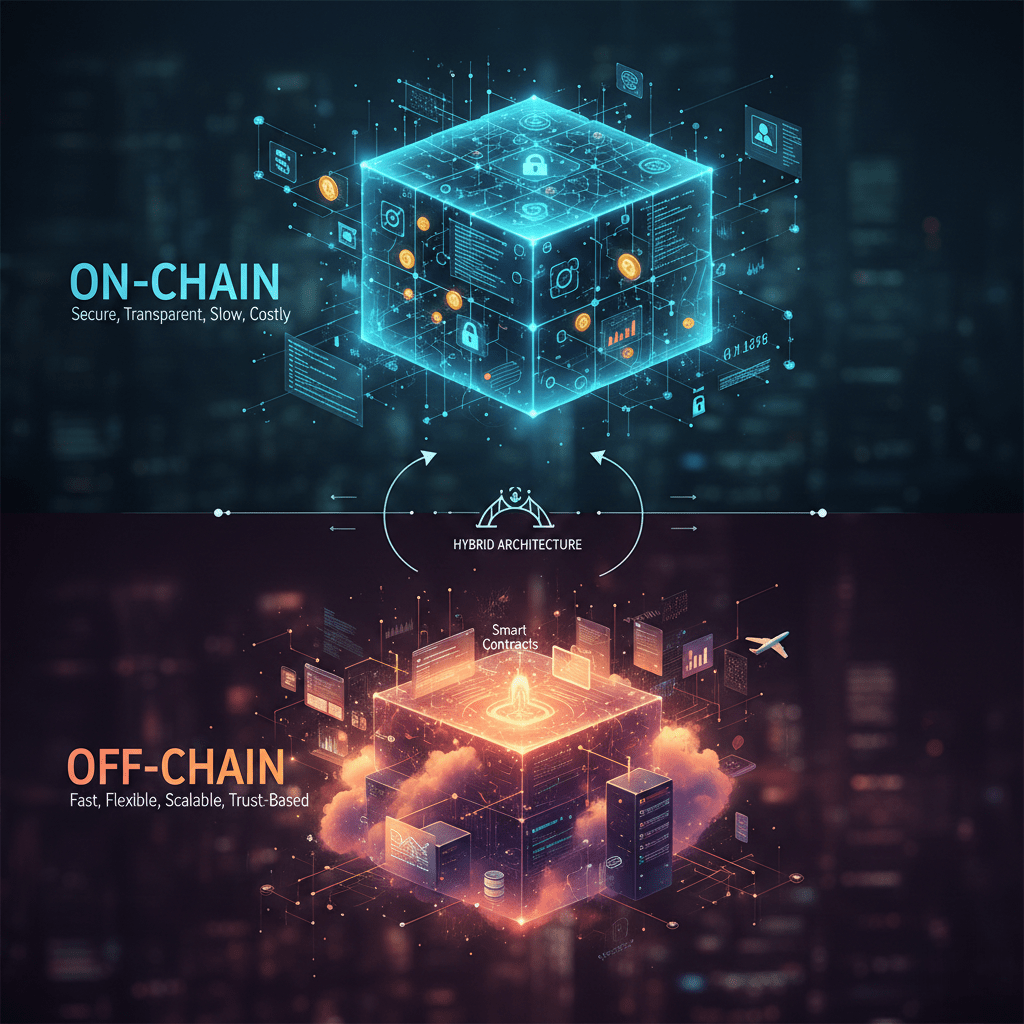
Typical on-chain activities include executing smart contracts, transferring tokens, managing ownership, and settling trades. Because on-chain transactions are processed through consensus, they offer high levels of security, transparency, and trust. Anyone can verify these transactions on the blockchain.
However, on-chain operations also come with limitations. They are slower compared to traditional systems, involve transaction fees (gas costs), and are not ideal for handling high-frequency or computation-heavy tasks.
What is Off-Chain?
Off-chain refers to processes that run outside the blockchain, usually on backend servers, databases, or application layers. These systems are not governed by blockchain consensus and therefore operate much faster and at lower cost.
Off-chain components typically handle user interfaces, data storage, price monitoring, analytics, automation services, and application logic. Because off-chain systems are flexible and scalable, they play a crucial role in delivering a smooth user experience.
The trade-off is that off-chain systems require trust in the platform operating them, as the data is not inherently immutable or publicly verifiable like on-chain data.
Why Both Are Needed
Using only on-chain systems would make applications secure but slow and expensive. Using only off-chain systems would make applications fast but reduce trust and transparency. To balance these trade-offs, modern blockchain platforms combine both approaches.
Critical actions that involve funds, ownership, or final settlement are executed on-chain to ensure security and integrity. Supporting operations such as monitoring, validation, automation, and user interaction are handled off-chain to improve performance and usability.
This hybrid architecture allows blockchain applications to scale while maintaining trust.
A Practical Example
Consider a trading platform built on blockchain technology. A user interacts with the application through a web interface, which runs off-chain. Market prices are monitored off-chain in real time. When predefined conditions such as stop loss or take profit are met, the system triggers an on-chain smart contract transaction to close the position.
In this model, the decision-making and monitoring happen off-chain for speed, while the final execution happens on-chain for security and transparency.
Conclusion
On-chain and off-chain systems are not alternatives—they are complementary parts of a complete blockchain architecture. On-chain provides trust, transparency, and security. Off-chain provides speed, flexibility, and scalability.
By combining both effectively, blockchain platforms can deliver reliable, efficient, and real-world-ready applications.
