
Post Date: October 12, 2018
Last Updated: September 29, 2026
Introduction
Python is a beginner-friendly programming language, but errors are a normal part of learning and development.
Understanding common errors helps beginners identify the cause of a problem and fix it quickly. In this article, we cover some of the most common Python errors, including indentation errors, syntax errors, logic errors, NameError, IndexError, and file-related errors.
1. Indentation Errors
Python uses indentation to define blocks of code. An indentation error usually occurs when spaces and tabs are used inconsistently.
For example:
if age >= 18:
    print("You are eligible")
The statements belonging to the same block should use the same indentation level.
Indented Blocks in Python
Python commonly uses four spaces for each level of indentation.
Indentation is required for:
- if statements
- for loops
- while loops
- Functions
- Classes
- Other code blocks
Example:
if age >= 18:
    print("Adult")
    print("Eligible")
Using inconsistent indentation can result in an IndentationError.
2. Syntax Errors
A syntax error occurs when Python cannot understand the structure of the code.
For example:
def some_function()
    msg = "Hello, World!"
    print(msg)
The function definition is missing a colon (:).
Correct version:
def some_function():
    msg = "Hello, World!"
    print(msg)
Python will report an error similar to:
SyntaxError: invalid syntax
Always check the line mentioned in the error message and review the surrounding code for missing characters, brackets, or incorrect syntax.
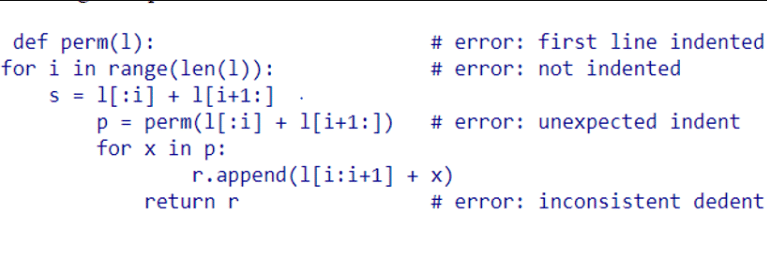
3. Common Indentation Errors
Two common indentation errors are:
- unexpected indent
- unindent does not match any outer indentation level
These errors usually occur when the indentation level is incorrect or inconsistent.
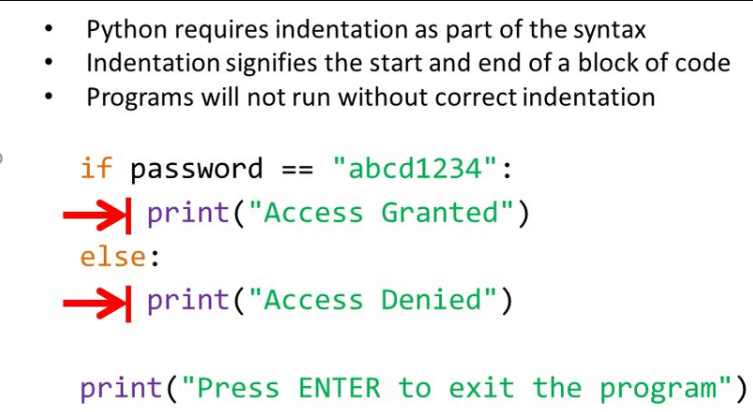
4. Print Statement Should Have the Correct Indentation
The print() statement must follow the indentation level of the code block it belongs to.
For example:
if True:
    print("Hello")
Incorrect indentation can cause Python to stop execution and display an IndentationError.
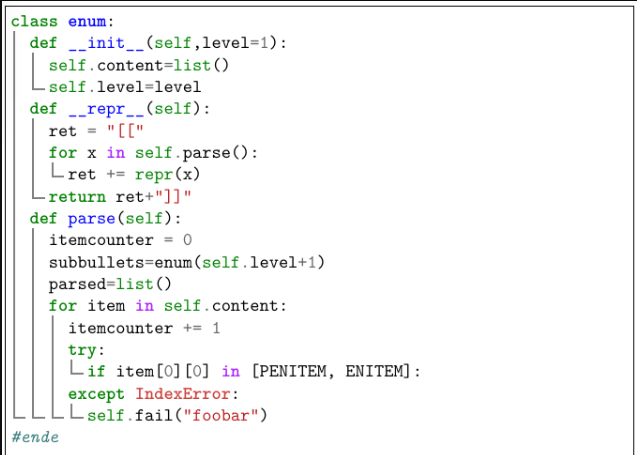
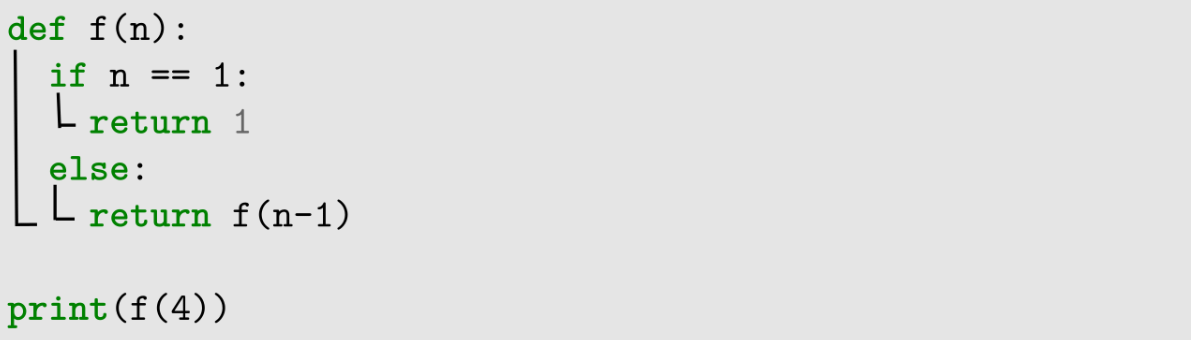
5. Syntax and Indentation Flow
Indentation should follow a consistent structure for statements such as:
- if
- for
- while
- Functions
- Classes
Example:
def welcome():
    if True:
        print("Welcome")
Each nested block should be indented consistently.
6. Syntax Errors
Syntax errors are among the most common errors encountered by beginners. They occur when the Python interpreter cannot understand the code.
For example:
def some_function()
    msg = "hello, world!"
    print(msg)
    return msg
The function definition is missing the colon:
def some_function():
Python will display:
SyntaxError: invalid syntax
Common Causes of Syntax Errors
- Missing :
- Missing brackets or parentheses
- Missing quotation marks
- Incorrect indentation
- Misspelled keywords
- Incorrect use of operators
Carefully reading the error message can usually help identify the location of the problem.
7. Logic Errors
Logic errors occur when the program runs without producing a syntax error, but the result is not what you expected.
For example:
price = 100
discount = 10

final_price = price + discount
print(final_price)
If the intention is to calculate the price after applying a discount, the logic should be:
final_price = price - discount
print(final_price)
How to Find Logic Errors
You can:
- Check the expected and actual output.
- Print intermediate values.
- Test individual sections of the program.
- Use a debugger.
- Review the program logic step by step.
8. NameError
A NameError occurs when Python cannot find a variable or function that you are trying to use.
Example:
print(a)
Python will return:
NameError: name 'a' is not defined
Solution
Define the variable before using it:
a = 10
print(a)
Another common mistake is forgetting quotation marks when printing a string.
Incorrect:
print(Hello)
Correct:
print("Hello")
9. IndexError
An IndexError occurs when you try to access an item using an index that does not exist.
Consider this example:
letters = ['a', 'b', 'c']

print("Letter #1 is", letters[0])
print("Letter #2 is", letters[1])
print("Letter #3 is", letters[2])
print("Letter #4 is", letters[3])
The list contains only three items, so the available indexes are 0, 1, and 2.
Trying to access letters[3] results in:
IndexError: list index out of range
Always make sure that the index you are accessing exists in the list.
10. File Errors
File-related errors commonly occur when Python cannot find a file or when an operation is not supported for the selected file mode.
FileNotFoundError
Consider:
file_handle = open("myfiles.txt", "r")
If myfiles.txt does not exist in the expected location, Python will return:
FileNotFoundError: [Errno 2] No such file or directory
Make sure the file exists and provide the correct path when necessary:
file_handle = open("MyProject/local/myfiles.txt", "r")
Using pathlib is another recommended way to work with file paths:
from pathlib import Path

file_path = Path("MyProject/local/myfiles.txt")

with file_path.open("r") as file:
    content = file.read()
UnsupportedOperation
This error can occur when you perform an operation that is not supported by the selected file mode.
For example:
file_handle = open("myfiles.txt", "w")
file_handle.read()
The file was opened in write mode, so Python cannot read from it.
The result will be similar to:
UnsupportedOperation: not readable
Use the correct mode depending on the operation:
with open("myfiles.txt", "r") as file:
    content = file.read()
For writing:
with open("myfiles.txt", "w") as file:
    file.write("Hello World")
Common Python Errors at a Glance
| Error | Common Cause |
|---|---|
| IndentationError | Incorrect or inconsistent indentation |
| SyntaxError | Invalid Python syntax |
| NameError | Variable or function is not defined |
| IndexError | Index does not exist |
| FileNotFoundError | File or path cannot be found |
| UnsupportedOperation | Invalid operation for the selected file mode |
| Logic Error | Program runs but produces an incorrect result |
Conclusion
Errors are a normal part of programming, especially when learning Python. Understanding the error message and identifying its root cause can make troubleshooting much easier.
By practicing proper indentation, checking syntax, validating variables and indexes, and handling files correctly, beginners can avoid many common Python errors and improve their programming skills.
FAQs
1. Why do indentation errors occur in Python?
Indentation errors occur when code blocks are not properly aligned or when tabs and spaces are mixed.
2. What is a SyntaxError?
A SyntaxError occurs when Python cannot understand the structure or syntax of the code.
3. What causes a NameError?
A NameError usually occurs when you try to use a variable or function that has not been defined.
4. What causes an IndexError?
An IndexError occurs when you try to access an index that does not exist in a list or another sequence.
5. How can I fix a FileNotFoundError?
Check whether the file exists and verify that the file path is correct.
Related Articles
Python Script to Take Backup of Folder to Amazon S3 on Windows
Talk to Our Experts
Need help with Python development or other technology solutions? Our experts can help you build and manage the right solution for your business.
Get in touch with us: https://pheonixsolutions.com/contact
Thank u for giving information about indentation