
Objective
The objective of this module is to design and implement a scalable Role-Based Access Control (RBAC) system for enterprise web applications. The architecture enables administrators to define roles, assign permissions, and enforce secure authorization across both frontend and backend services while maintaining flexibility for future role expansion.
Requirements
Functional Requirements
- Role Management: Create, update, and delete user roles dynamically.
- Permission Mapping: Associate multiple permissions with each role.
- Route Protection: Restrict access to frontend pages and backend APIs based on assigned permissions.
- Dynamic UI Rendering: Display menus, buttons, and actions according to the authenticated user’s permissions.
- Centralized Authorization: Validate permissions consistently across all application layers.
Non-Functional Requirements
- Scalability: Support future addition of roles and permissions without major code changes.
- Security: Prevent unauthorized access through server-side validation.
- Maintainability: Separate authentication and authorization logic.
- Performance: Minimize permission lookup overhead using optimized data structures or caching.
Pre-Requisites
Authentication Layer
- JWT-based authentication
- Secure login flow
- Token validation
Backend
- Node.js
- Express.js
Database
- MongoDB
Frontend
- React
- TypeScript
Solution
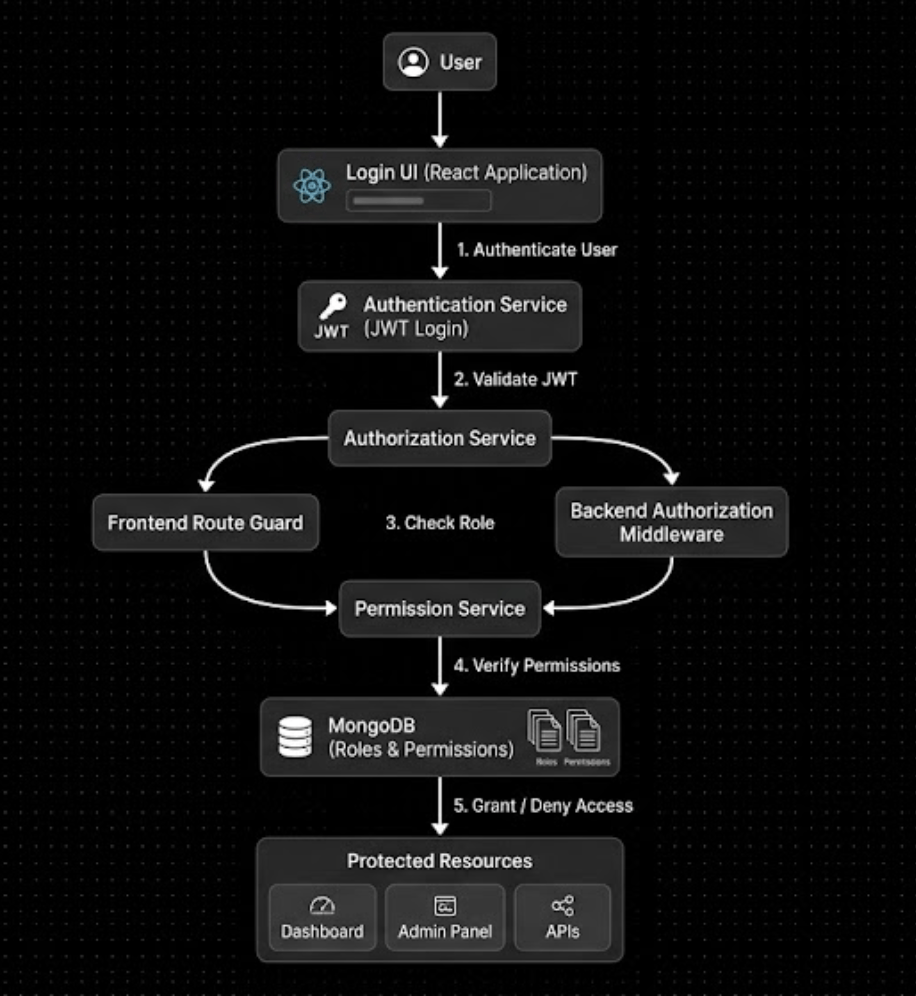
The RBAC implementation follows a layered authorization architecture.
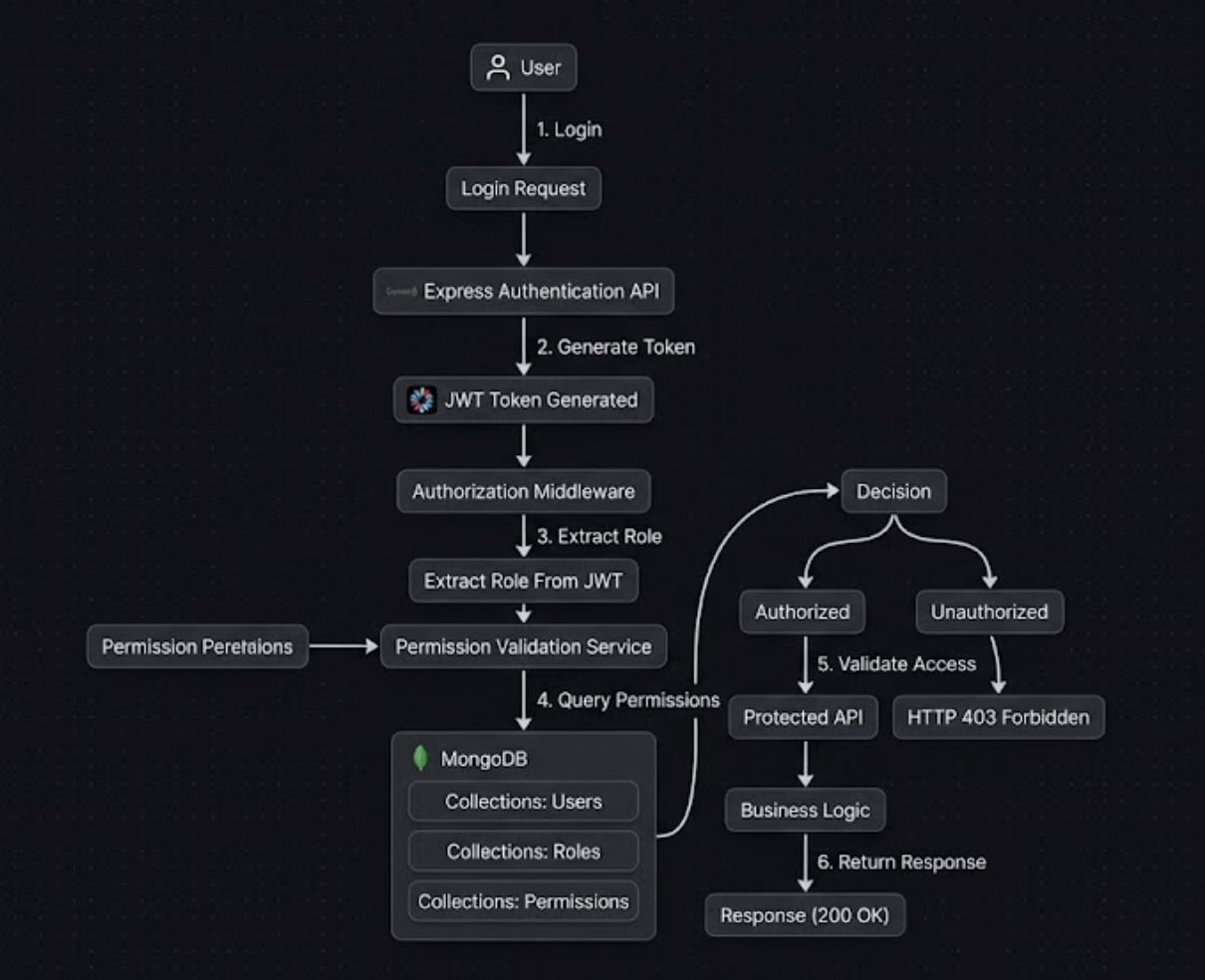
Centralized Permission Service
A dedicated authorization layer validates user permissions before allowing access to protected resources.
Role-Permission Mapping
Roles maintain a configurable list of permissions rather than hardcoded access checks.
Frontend Route Guards
Protected routes verify required permissions before rendering components.
Backend Middleware
API requests pass through authorization middleware to ensure only authorized users can execute sensitive operations.
High-Level Design (HLD)
Low-Level Design (LLD)
Tech Stack
- Frontend: React, TypeScript
- Backend: Node.js, Express.js
- Database: MongoDB
- Authentication: JWT
- Authorization: Role-Based Access Control (RBAC)
Challenges
Permission Duplication
Managing repeated permission checks across multiple modules can lead to inconsistent authorization logic. A centralized permission service eliminates duplicate validation code.
Frontend Security Misconception
Hiding UI elements alone does not provide security. All permission checks must also be enforced on the backend.
Role Expansion
Hardcoded role conditions become difficult to maintain as applications grow. Dynamic role-permission mapping enables easy introduction of new roles without modifying business logic.
Performance Optimization
Repeated database lookups for permissions can increase response time. Caching user permissions within JWT claims or an in-memory cache helps reduce authorization overhead.
FAQ
1. What is the difference between Authentication and Authorization?
Authentication verifies the identity of a user, while authorization determines what resources the authenticated user is allowed to access.
2. Why is backend authorization necessary if the frontend already hides restricted features?
Frontend restrictions improve user experience but can be bypassed. Backend validation is essential to prevent unauthorized API access.
3. Can a user have multiple roles?
Yes. Enterprise RBAC implementations often support multiple roles, with permissions aggregated from all assigned roles.
4. How can new roles be added without modifying application logic?
By storing role-permission mappings in the database or a configuration layer, new roles can be introduced without changing authorization code.