
In modern web applications, enabling seamless and secure payments is essential for business operations. Whether users are purchasing subscriptions, booking services, or buying event tickets, the payment experience directly impacts user trust and conversion rates. However, handling payments manually or without a proper integration often leads to inconsistencies, failed transactions, and security risks.
To address these challenges, a dedicated Cashfree Payment Integration Module can be implemented as part of the application architecture. This module is responsible for managing the complete payment lifecycle, including order creation, payment processing, verification, and transaction tracking.
This blog presents the design of a Cashfree Payment Integration Module for a web application. The module aims to ensure secure transactions, accurate payment status handling, and a scalable foundation for future enhancements such as refunds, subscriptions, and financial reporting.
1. Requirements
The primary goal of this module is to provide a reliable and secure payment experience while ensuring that all transactions are accurately recorded and verified. The system should minimize manual intervention and handle edge cases effectively.
1.a. Functional Requirements
The system should support the following functional requirements:
- The system should allow users to initiate a payment for a selected product or service.
- The backend should be able to create a payment order using Cashfree APIs with details such as amount, currency, and customer information.
- The system should generate and return a payment session identifier to the frontend for initiating the payment.
- The frontend should be able to redirect users to the Cashfree payment interface or use SDK-based integration.
- The system should support multiple payment methods such as UPI, credit/debit cards, and net banking.
- The backend should handle webhook notifications from Cashfree to receive real-time payment status updates.
- The system should verify webhook requests using HMAC signature validation to ensure authenticity.
- The payment status (success, failed, pending) should be updated accurately in the database.
- The system should maintain transaction history with details such as order ID, payment status, amount, and timestamp.
- The module should support retry mechanisms for failed or pending payments.
- The system should be designed in a way that allows future extension for refunds and payment reconciliation.
1.b. Non-functional Requirements
The module should also satisfy the following non-functional requirements:
- The system must ensure high security by validating all incoming payment-related requests and avoiding exposure of sensitive data.
- The payment processing flow should be reliable, ensuring that transaction states remain consistent even in cases of network failures or interruptions.
- The system should be scalable to handle a large number of concurrent payment requests without performance degradation.
- The payment experience should be fast and responsive to reduce user drop-offs during checkout.
- The module should be highly available, especially during peak usage times.
- The system should maintain data consistency between the application database and the payment gateway.
- The architecture should be modular and maintainable to support future enhancements such as subscription billing and analytics.
2. Pre-requisites
Before implementing the Cashfree Payment Integration Module, the following pre-requisites should already be in place:
- A backend system capable of handling API requests and business logic
- A frontend application for user interaction and payment initiation
- A database for storing order and transaction details
- User authentication and authorization mechanisms
- Access to Cashfree merchant account and API credentials
- Secure environment configuration for storing API keys and secrets
- Basic understanding of webhooks and API integrations
- UI components for checkout and payment status display
- A deployment environment with HTTPS enabled
These pre-requisites are essential because payment processing requires secure backend handling, proper data storage, and seamless communication between multiple components.
3. Solutions
There are multiple approaches to handling payments in a web application.
The first approach is to implement a basic or manual payment tracking system, where transactions are recorded without proper gateway verification. While this approach may work for small-scale applications, it is not reliable and can lead to incorrect payment records, fraud risks, and poor user experience.
The second approach is to integrate a payment gateway like Cashfree using a frontend-only flow. In this case, the frontend directly handles payment interactions. However, this approach is not secure because it lacks proper backend verification and can lead to inconsistencies in payment status.
The recommended approach is to build a backend-driven payment integration module using Cashfree APIs and webhook verification. In this approach, the backend is responsible for creating orders, validating payments, and updating transaction records.
This solution provides:
- Accurate and verified payment tracking through backend validation
- Improved security by preventing tampering and unauthorized updates
- Better reliability through webhook-based confirmation
- Centralized control over payment operations
- Scalability for handling high transaction volumes
Therefore, a backend-integrated payment module is the most reliable and production-ready solution for handling online transactions.
4. Low Level Design (LLD)
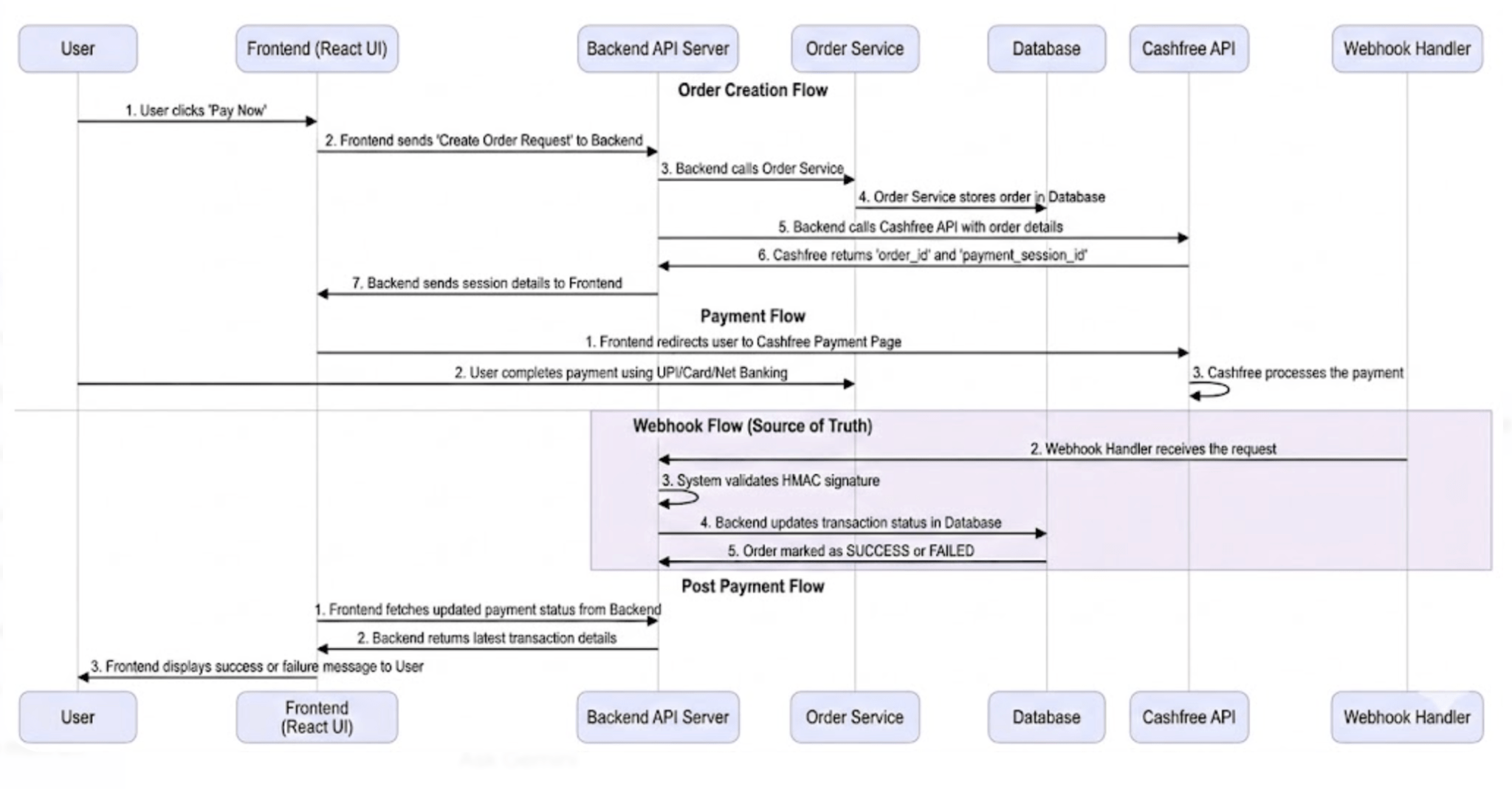
5. High Level Design (HLD)
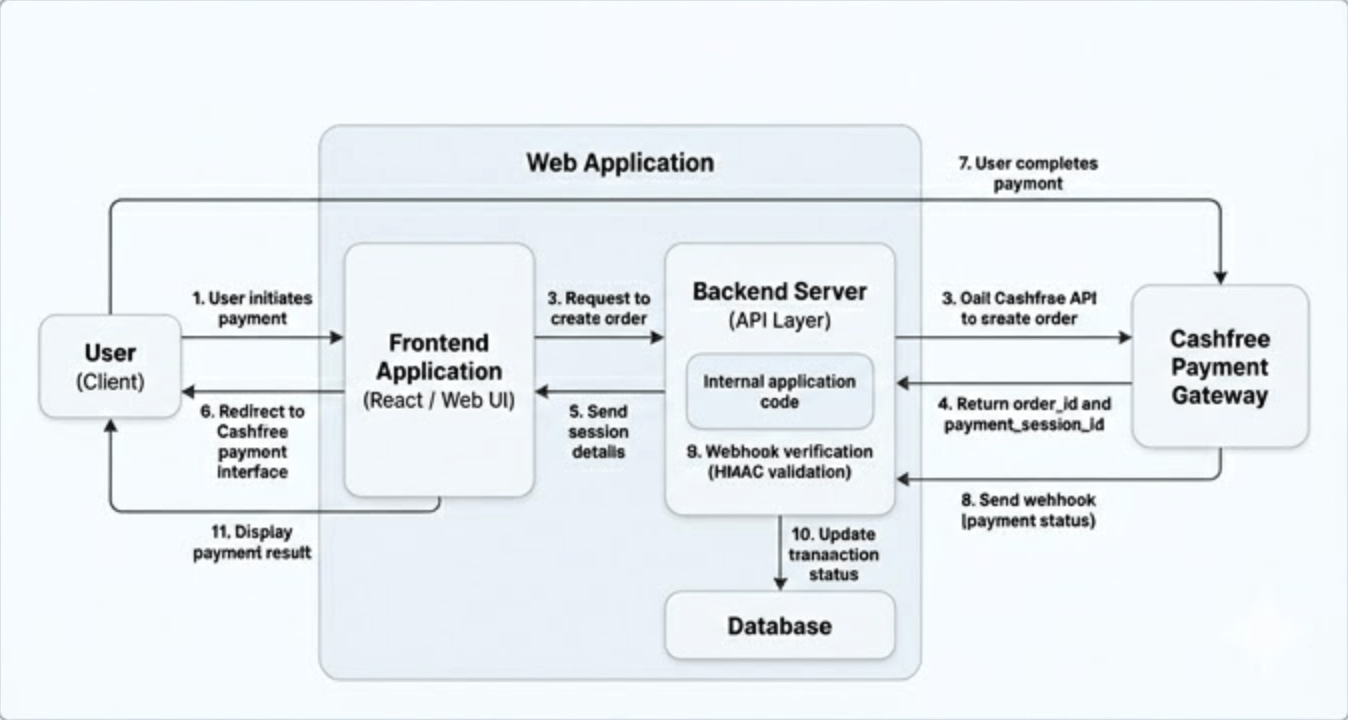
6. Tech Stack
The following technology stack can be used to implement this module:
- Frontend: React.js or Next.js
- Backend: Node.js with Express.js
- API Layer: REST APIs
- Database: MongoDB or PostgreSQL
- Payment Gateway: Cashfree Payments API
- Authentication: JWT-based authentication
- Security: HMAC signature verification and HTTPS
This stack is suitable because it supports scalable backend processing, secure communication, and efficient frontend interactions.
7. Challenges
Implementing a payment integration module involves several real-world challenges.
One major challenge is handling duplicate payment attempts. Users may click the payment button multiple times, leading to multiple order creations. This requires implementing idempotency and unique order handling.
Another challenge is ensuring accurate payment status. There may be cases where the frontend indicates success, but the backend does not receive confirmation due to network issues. This is resolved by relying on webhook verification instead of frontend responses.
Security is a critical concern, especially when handling webhook requests. If webhook validation is not implemented properly, unauthorized requests may alter transaction data. HMAC signature verification is essential to prevent such risks.
Handling edge cases such as network failures, delayed responses, and incomplete transactions is also complex. The system must be designed to recover gracefully and maintain consistent data.
Finally, maintaining synchronization between the payment gateway and the application database is crucial. Any mismatch can lead to incorrect transaction records and affect user trust.
8. FAQs
1. Why is backend verification important in payment integration?
Backend verification ensures that payment status is confirmed using a trusted source (webhook) rather than relying on potentially unreliable frontend responses.
2. What role does a webhook play in Cashfree integration?
A webhook provides real-time updates from Cashfree about payment status, allowing the backend to update transaction records accurately.
3. Can payments be marked successful without webhook verification?
No, it is not recommended. Webhook verification is necessary to ensure the authenticity and accuracy of the transaction.
4. How does the system handle failed or pending payments?
The system can allow users to retry payments and update transaction status accordingly based on webhook responses.
5. Is the module scalable for high transaction volumes?
Yes, the architecture is designed to handle multiple concurrent transactions and can be extended for large-scale applications.
9. Conclusion
The Cashfree Payment Integration Module is a critical component of modern web applications that require secure and reliable payment processing. By implementing a backend-driven approach with proper webhook verification, the system ensures accurate transaction handling and improved security.
Replacing manual or frontend-only payment handling with a structured integration significantly enhances system reliability and user trust. As applications grow, this module can be extended to support advanced features such as refunds, subscriptions, and financial analytics, making it a scalable and future-ready solution.