
Post Date: December 12, 2020
Last Updated: November 22, 2026
Introduction
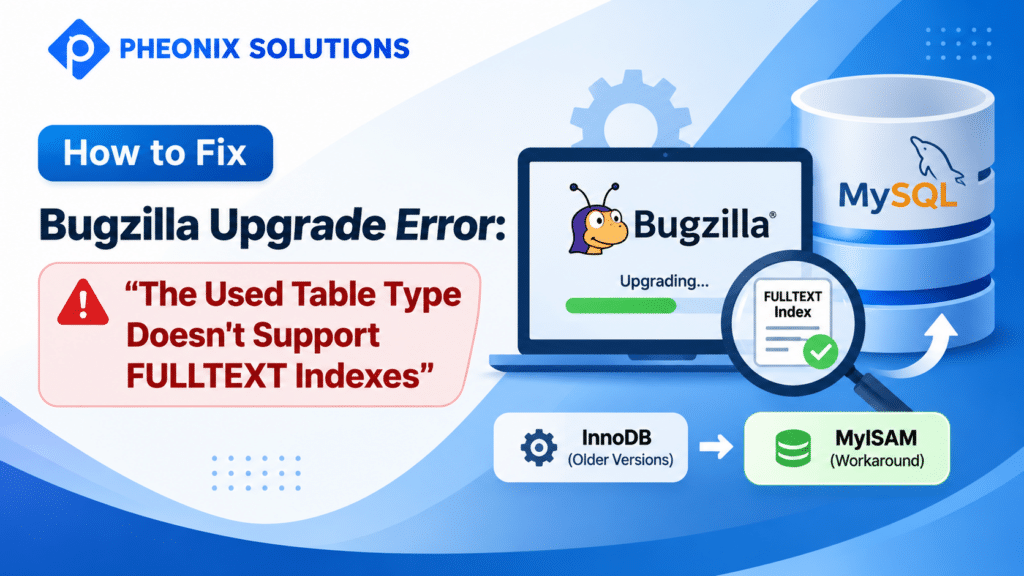
While upgrading Bugzilla, you may encounter a Bugzilla upgrade error: “The used table type doesn’t support FULLTEXT indexes” when running the ./checksetup.pl script.
This MySQL FULLTEXT index error is generally related to database version compatibility and storage engine configuration. FULLTEXT indexes are used to search text data efficiently. Older MySQL versions do not support FULLTEXT indexes on InnoDB tables.
We encountered this issue during a Bugzilla upgrade. After checking the MySQL version and making the necessary database engine adjustments, we successfully completed the upgrade.
In this guide, we will explain how to identify the Bugzilla upgrade error, check your MySQL version, apply the appropriate fix, and rerun the Bugzilla setup script.
Understanding the Error
The error occurs when MySQL attempts to create or modify a FULLTEXT index using a storage engine that does not support that operation.
For example, you may encounter an SQL statement similar to:
ALTER TABLE bugs_fulltext ENGINE=InnoDB;
Older MySQL versions do not support FULLTEXT indexes on InnoDB tables. In such cases, changing the table engine to MyISAM can be a workaround.
However, MySQL 5.6.4 and later support FULLTEXT indexes on both InnoDB and MyISAM.
Step-by-Step Solution
Step 1: Check the MySQL Version
First, check the installed MySQL version on your server.
Run the following command:
mysql --version
You can also check the version directly from the MySQL console:
SELECT VERSION();
If you are using an older MySQL version, check whether it supports the required FULLTEXT index functionality before proceeding.
Step 2: Choose the Appropriate Solution
You have two possible approaches:
Option 1: Upgrade MySQL
If your current MySQL version does not support FULLTEXT indexes on InnoDB, upgrading MySQL to a compatible version is the recommended long-term solution.
Before upgrading, verify Bugzilla compatibility with the target database version and take a complete database backup.
Option 2: Change the Table Engine to MyISAM
If upgrading MySQL is not currently possible, you can consider changing the affected table to MyISAM, provided it is compatible with your Bugzilla version and application requirements.
Step 3: Locate the SQL Statement
Go to your Bugzilla installation directory and locate the SQL statement or upgrade script that contains the affected table engine definition.
For example, you may find:
ALTER TABLE bugs_fulltext ENGINE=InnoDB;
For an older MySQL server that requires the workaround, change it to:
ALTER TABLE bugs_fulltext ENGINE=MyISAM;
Important: Modify only the relevant Bugzilla upgrade SQL statement after verifying the compatibility. Do not blindly replace every occurrence of InnoDB in your MySQL configuration or database.
Experiencing MySQL FULLTEXT index errors during a Bugzilla upgrade? Our team can help with MySQL database troubleshooting, Bugzilla upgrades, server maintenance, and reliable infrastructure management.
Explore our DevOps & Cloud Services to learn more.
Step 4: Run the Bugzilla Setup Script Again
After applying the appropriate change, navigate to your Bugzilla installation directory.
Run:
./checksetup.pl
The script will check the database and continue the setup process.
If the issue has been resolved, you should see a successful completion message similar to:
checksetup.pl completed successfully
Step 5: Verify the Database
After completing the upgrade, verify the storage engine of the affected table.
Connect to MySQL and run:
USE bugs;

SHOW TABLE STATUS LIKE 'bugs_fulltext';
Check the Engine column to confirm the table is using the expected storage engine.
You should also verify that Bugzilla is accessible and that its search functionality works correctly.
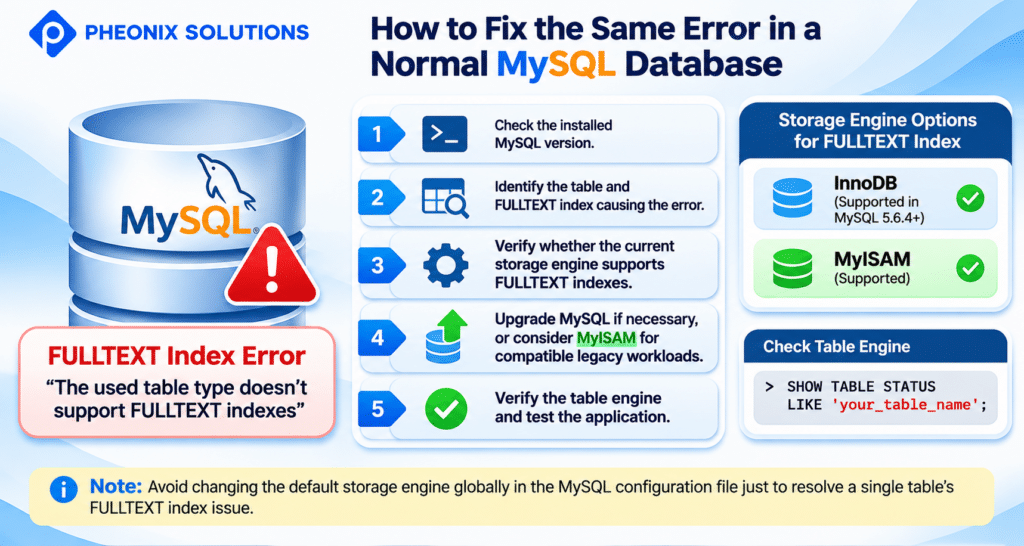
How to Fix the Same Error in a Normal MySQL Database
If you encounter the same FULLTEXT index error in a regular MySQL database that is not related to Bugzilla, follow the same troubleshooting approach.
- Check the installed MySQL version.
- Identify the table and FULLTEXT index causing the error.
- Verify whether the current storage engine supports FULLTEXT indexes.
- Upgrade MySQL if necessary, or consider MyISAM for compatible legacy workloads.
- Verify the table engine and test the application.
You can check the table engine using:
SHOW TABLE STATUS LIKE 'your_table_name';
Note: Avoid changing the default storage engine globally in the MySQL configuration file just to resolve a single table’s FULLTEXT index issue.
Conclusion
The “The used table type doesn’t support FULLTEXT indexes” error can occur during Bugzilla upgrades when the MySQL version and table storage engine are incompatible.
By checking the MySQL version, identifying the affected SQL statement, and choosing the appropriate storage engine or database upgrade, you can resolve this issue and complete the Bugzilla upgrade successfully.
We recommend upgrading to a compatible MySQL version rather than using MyISAM as a permanent workaround, especially for production environments.
Always take a database backup before modifying table engines or upgrading MySQL to protect your existing data.
Frequently Asked Questions (FAQs)
1. What does “The used table type doesn’t support FULLTEXT indexes” mean?
This error means that the selected MySQL storage engine does not support the FULLTEXT index operation being performed. It can also occur when using an older MySQL version that does not support FULLTEXT indexes on InnoDB tables.
2. How do I check my MySQL version?
Run the following command from your Linux terminal:
mysql --version
Alternatively, execute SELECT VERSION(); inside the MySQL console.
3. Does InnoDB support FULLTEXT indexes?
Yes. MySQL introduced FULLTEXT index support for InnoDB in version 5.6.4. MyISAM also supports FULLTEXT indexes.
Related Articles
How to Copy a Table from One Database to Another in MySQL?
How to Disable/Lock a MySQL User Account from CLI?
Talk to DevOps and Cloud Experts
Maintaining a reliable Bugzilla environment requires proper database configuration, regular maintenance, and a secure infrastructure setup. At Pheonix Solutions, our team helps businesses manage their servers, databases, cloud infrastructure, and application environments.
We can help you with:
- DevOps and cloud services for infrastructure management, automation, cloud deployment, and server optimization.
- Website development with Core Web Vitals built in from the first release.
- Software maintenance and support to keep applications reliable and running smoothly after updates.
Need help troubleshooting MySQL errors, upgrading Bugzilla, or maintaining your server infrastructure? Talk to our DevOps and Cloud experts to discuss your requirements.